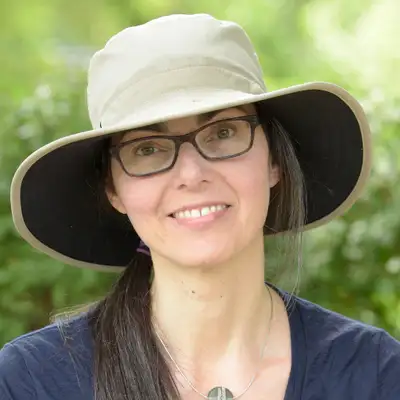
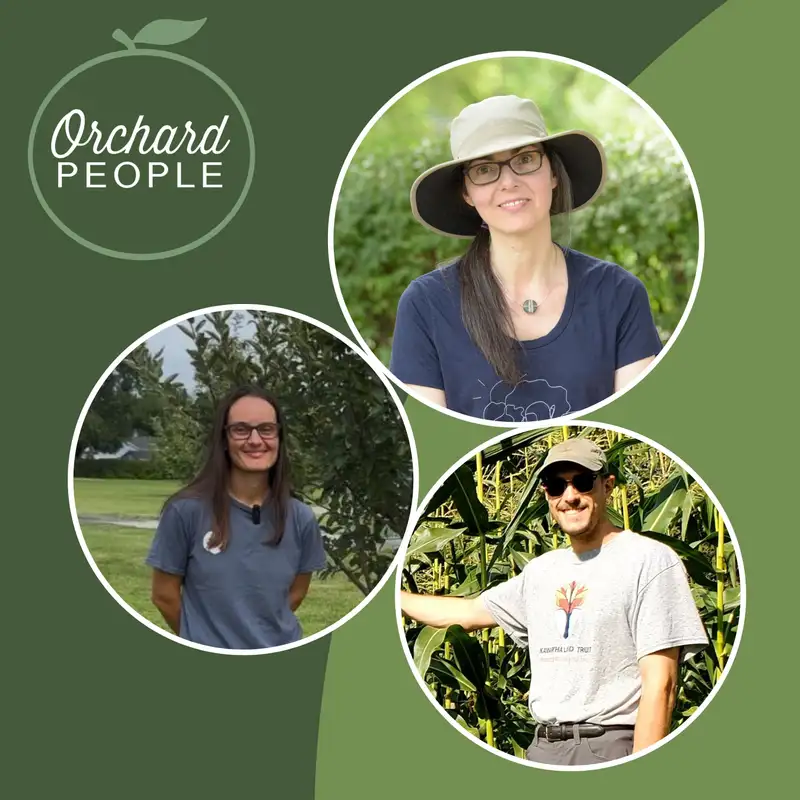
Why do some fruit trees thrive while others struggle? with Derek Barbe and Chrisina Balint
Download MP3[00:00:00] Orchard Soil Mystery
Susan: Hey, everybody, and welcome to the show today.
I recently visited two community orchards in Peterborough, Ontario, and they're managed by a group called GreenUP.
It is a wonderful environmental group, and they do all sorts of work to create healthier, more sustainable communities.
So these two orchards gave us a really interesting mystery to investigate.
In one of the orchards, the fruit trees were thriving,
and in the other one, the trees seemed quite small even though they were planted around the same time.
So we wondered, could part of the answer be in the soil?
, We collected soil samples from both orchards
and sent them to soil microscopy expert Derek Barbe, and today we're gonna find out what he discovered.
So we'll hear from Derek, and we're also gonna hear from
Christina Balint of GreenUP, and
she's going to talk about the orchards themselves and the work they're doing in Peterborough.
Now, whether you are a community orchardist or whether you're just growing one or two fruit trees at home, you are going to learn so much from this episode.
So
get ready, take some notes, and let's dig in.
[00:01:13] Microscopy vs Soil Tests
Susan: So Derek, can you tell me a little bit about how the soil testing that you do is different from chemical soil tests?
Derek: They're completely different.
I'm using a microscope to verify biological quantities of organisms. I'm not actually looking at the chemical analysis at all.
Susan: So from what I understand, you can have all the nutrients you want in the soil naturally- and the tree can't get those nutrients unless there's organisms in the soil. Am I right?
Derek: Yeah, for sure. They form a mutual relationship with plants. It's symbiotic. So the plants or trees, they release sugars as exudates through the roots, and then the microorganisms feed on that, particularly bacteria and the fungi.
When those organisms either die or they poop, is a plant-available form of nutrients.
[00:02:18] Keith Whiteman Orchard Tour
Susan: Christina, can I get you to talk to me briefly about the first site that we visited?
That's the Keith Wightman Community Orchard. Tell me a little bit about that orchard, how old it is, and about the health of those trees there.
Christina: It's about five years or so. I think it was planted in 2021 or 2022. There's about 15 trees. We've got mostly apples, but a couple pears, a couple cherries, a couple plums.
It's right beside a school, there are a lot of kids, and it gets a lot of attention, but also maybe sometimes a flying soccer ball that might go and damage a tree.
We have a team of local, community orchard stewards that will help take care of it because all of our orchards are on public property, which is great
in the hopes that as fruit grows and develops and becomes available, that people around town feel free to harvest and actually know what a fresh apple tastes like.
So we have actually a few new orchard stewards at that park, and they've met recently, and they do great work, and I think that's part of the reason why it looked so healthy.
Susan: So let's go to Derek now.
[00:03:27] Keith Soil Results
Susan: In this first site, you did your soil test. Can you tell us what you discovered?
Derek: So this is a soil biology report. We'll start at the beneficial microorganisms. So for an orchard, they thrive with lots of fungi. We don't have much. There was some beneficial fungi.
Susan: The recommended range for fungi says 635 to 9,000.
Derek: So that would be micrograms per grams of soil. So we only have three micrograms per gram.
Susan: Wow. So that's very low.
Derek: Very low, which is typical of a synthetically fertilized plot of anything.
Trees. Vegetables.
Susan: If it was like a big commercial orchard where there wasn't a lot of natural organic matter and they're pumping in chemicals in order to feed the trees- would you see those results?
Derek: You would see these results for sure.
The high level of salt just suppresses msot biology. Fungi is pretty susceptible too, so.
Susan: And so commercial fertilizers are high in salts, and that kills the organisms in the soil.
If you're using synthetic fertilizers, you're bypassing the organisms in the soil.
You don't need them anymore because you're putting the nutrients in the soil in a plant-accessible form. The plant can take it in directly. It doesn't need those organisms, and those organisms can just take off and die and just go away because they're not necessary.
That's why the trees get hooked.
You have to pump them up with nutrients. Okay.
Derek: Yeah, that's perfect.
[00:05:12] Fungi Under the Microscope
Derek: So this is a typical microscope slide. This is a very small area of snapshot of your soil.
This here is a fungal hyphae. So it's about three micrometers in diameter, and then the length of it is probably, let's say, 50 micrometers, maybe a little bit more.
Susan: Sorta looks like a long, skinny worm.
Derek: Yeah, it's a little... It's a strand of individual fungal hyphae.
Susan: Okay.
Derek: So this is good. This is a beneficial fungus. There are other types of fungi that aren't. They're disease causers. They're like your mildews and stuff like that.
Susan: Okay.
Derek: So that's good to see.
We just don't have a substantial amount of it. We have barely any. This is just one tiny strand. We wanna be seeing this everywhere.
Susan: Gotcha.
Derek: This is another piece of fungi here. It's a little more damaged, and you can't really see it as well. But that is another piece.
Susan: Also on this slide, we're seeing a lot of pieces of what look like little crystals.
Derek: That's your parent material. It could be little pieces of sand, but it's more like a silt or a clay just 'cause this is on such a small scale. So that is just your soil parent material.
Susan: And then there's big cloudy brown things. What are those?
Derek: So those are micro aggregates of soil. Those are organic matter glued together by the glues that microorganisms make. So they're building a little home, in a sense. That's a little castle, basically.
These ones are extremely tiny. So these are the building blocks of a bigger macro aggregate that you would see when you're shoveling. So this is good to see. This is the building blocks of what you want to see. It's just not enough.
[00:07:15] Bacteria and Fungal Ratio
Derek: For bacteria,
you wanna be within 135 to 900 micrograms per gram of soil. So I'm seeing 658, which is right in the middle. So this is a good bacterial biomass. But that's not really saying much 'cause bacteria is everywhere. You'd have to have a really damaged soil to not have bacteria in there.
So each slide will have bacteria.
It's very abundant. So something like this right here.
Susan: Ooh, teeny-tiny little spot on the slide.
Derek: Teeny-tiny. Only one micrometer in diameter. Very small.
This number here is your fungal to bacterial ratio.
Between how much fungi you have to how much bacteria you have. You're aiming to be in that sweet spot for your fungal to bacterial ratio. But it's a dynamic number changing on what you're growing.
Susan: So for fruit trees?
Derek: Between 5:1 (five to one) to 100:1 (one hundred to one), which is very fungally dominated.
You want a lot of fungi. We don't have barely any fungi, so ours is 0.01 to one.
Fungi are, they're not delicate, but they don't do well with tillage and compaction and pesticides and synthetic fertilizers.
[00:08:39] Protozoa and Nematodes
Susan: Now, let's look at the next part of this test. Protozoa?
Derek: These guys are the most mobile.
They're very important. We have zero.
So protozoa is the organism, and flagellates and amoebas are the type of protozoa.
Susan: And so there's zero.
Derek: We have none of the good guys there that would be eating this bacteria and turning over those goodie nutrients that are locked inside the bacteria.
Susan: Next is nematodes.
Derek: There is a specific type of nematode that is detrimental.
One that feeds on plant roots, so that can't obviously be good There are beneficial types. There's bacterial feeders, fungal feeders, and then there's predatory nematodes which eat the root feeders.
Susan: Your minimum value is 200 and this orchard had 105. That doesn't sound terrible.
Derek: No, it's not terrible. It's on the lower end.
So this is a nematode. This is a bacterial feeder.
So you are looking at a little, tiny worm type of creature.
Susan: It is a good guy. What's he doing? Is he hunting around for some bacteria to nibble on?
Derek: That's exactly what he's doing.
Susan: And compared to the size of the bacteria, this guy's big.
Derek: Yeah, he's one of the top predators.
Susan: Detrimental microorganisms is the last part here.
Derek: I did not see any disease-causing funguses.
You have to also remember this is such a small snapshot.
Susan: Yeah.
Derek: It's exactly like a chemical test, like you could be in the sweetspot and you could be in the spot with nothing.
[00:10:24] Boosting Soil Life
Susan: What are some of the ways that we can help to nurture the organisms in the soil so that they'll start to thrive so that they can support the fruit trees and the fruit trees can support them in that wonderful manner?
Derek: The best way to get beneficial organisms onto your plots of land is to get compost and apply that compost, whether it's through a liquid application or just a solid application. That's your best bet to increase these numbers.
Susan: Is it terrible to just take a bucket, mix some rainwater in with some compost and stir? Just stir it a little bit and then pour it on the soil around the trees?
Derek: No, that's a classic extract. That's actually a really good way to get the whole rhizosphere soaked. You're only as good as your compost.
You need to be sourcing some good compost, whether that's going to a worm farm and getting some good vermicompost.
[00:11:21] Reid/McDonnel Orchard Setup
Susan: Does anyone from GreenUP have any questions for Derek?
Christina: As part of Green Up, we plant Miyawaki little forests or mini forests
and we're doing an experimental Miyawaki Forest at Ecology Park itself to mimic more what the forest floor would look like, in planting those trees instead of bringing in wood chips and stuff like that. So after having the grass removed, we've put in compost but then have covered and mulched all that with leaf litter that's been sitting all summer to like slightly decompose and have all of its microorganisms there and eating and creating some of those fungal networks.
Susan: Something that I do like to do, we know that fruit trees, their most active area for taking in nutrients is at the outer edge of the canopy.
And your trees, they're healthy and they've gotten quite big, and it would be lovely to extend their mulch circles, like pull the grass back up to the edge of the canopy so they have bigger mulch circles so that when you are adding compost, you're not just doing it tightly around the tree trunk, you're actually putting it where the feeder roots are.
That might help.
What I can tell you is in Ben Nobleman Park where we grow our fruit trees, at first we had terrible soil. It was clay, rock hard, and no worms. I think it was last year I was weeding around the trees. I was shocked at how many worms had gathered in the soil in those mulch circles. Every year we're mulching with two inches of compost, we're weeding, which loosens the soil as well, and it makes a big difference.
Worms loved it there. So, there's hope.
Any comments from Quentin, Lorraine? We've also got you guys on the line.
Quentin: To promote more fungi are there things that, other than mulching, which we've been talking about, are you aware of anybody actually introducing fungi into their orchards?
Derek: Fungi's not just gonna show up per se. It will, over a long period of time, but between growing seasons, it's not really gonna increase unless you get a good compost in there that's rich in either spores or actual fungi. Once you have the fungi there, then you can start to foster it, whether it's give it fungal foods. Woodchips are fungal food. And then there's other things you can put in the soil, like fish emulsion and fish hydrolysate, which is another fungal food that can foster the fungi growing more.
But until you get compost in there that's rich in fungi, it's not just gonna come out of thin air. It'll take time to build it up, but compost is a biohack in a way.
Susan: I'm going to Christina. Can you describe briefly the Reid/McDonnel orchard, and why you had suggested that for the second orchard to contrast with our Keith Wightman community orchard at the school?
Christina: Lorraine had the observation that though the trees were around the same age as some of our other orchards, that they seemed a lot smaller.
They just weren't growing nearly as vigorously as some of the other orchards.
Susan: So Derek, back to you. Let's look at the test for number two and see how different it is or is not.
[00:15:00] Reid Soil Results
Derek: So this is the Reid/McDonnel result.
Susan: Fungi. The recommended range you had said, and it says here, is 675 to 9,000.
So what were our sample results here? We wanted 675 to 9,000, and I see we got 57.
Derek: Again, very low. A little bit better than last time.
It's a start. It's better than absolutely none.
Susan: So bacteria, our range is 135 to 900 micrograms per gram. Our result is 1,916 here it says. Lots of bacteria here.
Derek: There's an overabundance of bacterial biomass. The type of nitrogen that the bacteria release is a nitrogen form, nitrate, for example, a grass would prefer.
Susan: Oh.
Derek: It's not a great fit for a orchard tree. They prefer to have less bacteria, more fungi, and more ammonium. That's their preferred nitrogen form.
Susan: And here, nematodes. The minimum amount is 200. There were 168. That sounds okay.
Derek: That's not bad at all. The fact that we do have a bacterial-feeding nematode, is good.
So there's a little bit of nutrient cycling happening. We could have a lot more.
[00:16:35] Disturbance and Bad Microbes
Susan: Detrimental microorganisms. I'm seeing a bunch of zeros, and that's fantastic.
Derek: Again. Yeah, I didn't see any disease causers or root feeders.
You would see these go up even more if there were lots of disturbance. This type of disease causing fungi is more resilient. If you put down some sort of herbicide or pesticide, any -icide, the organisms that's more likely to survive are these oomycetes, these bad fungi. And these ciliates that are the bad protozoas.
Susan: So tillage. I'm trying to get into the head of a detrimental microorganism. They like it when you mess up the soil, when you're tilling the soil, which is breaking up the homes of all the good bacteria.
Why do they love disturbed soil?
Derek: So the attraction is low oxygen. These guys here, in particular, they can withstand the low oxygen conditions. Whereas the beneficials, they need those castles that have windows open, that have all the pore spaces in the soil that is always renewing oxygen into the soil, like into all these passageways.
So when you take away all those passageways and you compact and you till and you destroy soil structure, these guys are the only ones that can survive.
[00:18:03] Soil Testing Protocol
Susan: The other thing is when we did our testing, we did random testing and we did not take all the samples from right inside the mulch circles around the trees. We took them maybe further away.
And so it could be that the areas that have been mulched, maybe more of the organisms are closer to the trees.
Derek: Yeah.
Susan: So maybe a lesson learned. If we do this again, should we really be focusing only on the soil right inside of the rings?
Derek: Yeah, you should be focusing on the rhizosphere. So where those plant roots extend to and go down. That's where you'll have the concentration of organisms because they're being fed by the roots.
Susan: So it could be that the results are actually better than we see.
[00:18:52] Volunteer Lessons and Wrap Up
Susan: Christina, tell me what you think about this. What did you learn from this conversation?
Christina: When first coming onto the orchard project, it felt like more of a hands-off thing.
Learning more and more over this last year, I realize how hands-on that is, and then actually how many more volunteers we need and how many more volunteers we need to learn these things and to feel empowered to help the trees. And that it is a full-time care, besides maybe part of the winter.
I'm gonna have to look for funding to get more support for our community orchards because it's just not something that we're gonna have a lot of success on if we're not giving constant care to these fruit trees.
Susan: Quentin, did you wanna make any comments or share any thoughts or ideas?
Quentin: It's really pointed out to me, the value in investing in education around growing fruit trees. You don't need to educate everybody, but if you're going to have a community orchard system, you have to have sort of a core team that you are investing in educating so that they really know what they're doing, and then they can guide and direct other volunteers who maybe don't have the time or the inclination to spend so much time learning about it .
Lorraine: I agree with Quentin, with what he and Christina both are saying. I look at our trees, and even just doing your course this past winter, I learned so much, and I wish I knew that before I even started a little orchard at our community garden. And now the soil thing has just got my wheels turning, and I just wanna learn more.
So yeah, education is definitely up high on the list, to learn more. And I appreciate your knowledge, and every little bits help. Believe me.
Susan: Aw. That's so great. So Derek, what have you learned from tonight in communicating with GreenUP, learning about their plantings?
Derek: I just think it's a lovely project. I'm glad they're doing it.
Susan: Thank you so much to Derek Barbe for doing the soil microscopy testing and for joining me on the show to help us understand what he found, and a big thank you to Christina Balint of GreenUP, and to those GreenUP volunteers who joined us on the call and helped make this little soil investigation possible.
If today's episode made you curious about what's happening beneath your own fruit trees, there is so much more to explore in the Orchard People Podcast archives. I've done episodes on conventional soil testing, soil microscopy, improving soil health, and holistic approaches to fruit tree care, including my conversation with John Kempf about holistic sprays.
So there's lots of information there. Have a look, check out the archives, have a listen, and follow whatever catches your interest. I hope you really enjoyed coming along with me to Peterborough, Ontario, and discovering what these two very different orchards could teach us about soil and fruit tree health.
Thank you so much for listening, and I'll see you next time. Bye for now.
Creators and Guests