Watering and feeding fruit trees with Casey Clapp
Download MP3[00:00:00] Watering Meets Fertilizing
Susan: Welcome to the show. Today we're going to talk about something that trips up a lot of fruit tree growers, and it's
fertilizing and watering.
Watering and those things are often treated like two separate jobs, but
inside the tree they may actually be connected. So my question is:
What does happen when you water your tree,
and how does it affect whether your tree can access nutrients or minerals in the soil?
To help us understand this,
[00:00:30] Meet Arborist Casey
Susan: I'm going to be chatting with Casey Clapp. Casey is an arborist, an author, and an educator,
and the co-host of the wonderful podcast
Completely """""""Arbortrary."""ry.""".""'?"."ry."y."y."" — Casey, I'm so happy to have you on the show today!
Casey: Thank you so much for having me, Susan. I'm very happy to be talking with you.
[00:00:47] How Trees Drink
Susan: So what is actually happening when we are watering our fruit trees?
Casey: , It's the beginning of a really complicated story that
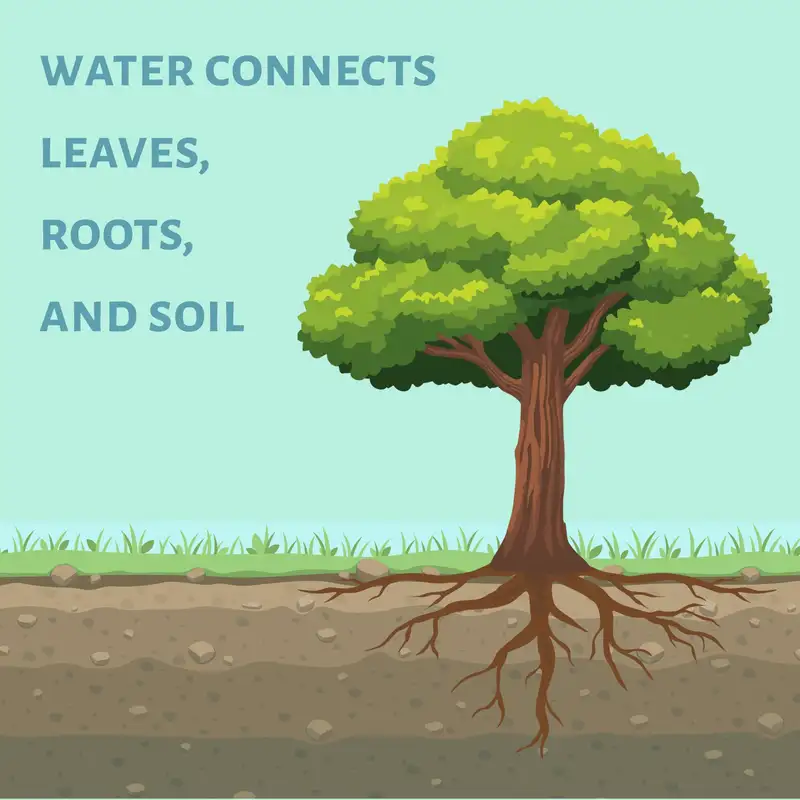
can be simplified as the atmosphere-tree-soil continuum.
And it's all filled with water to some degree. There's air filled with water around us. The tree itself has water in it, and then there's soil water in the ground as well.
What a tree is doing is — they're not really drinking in the way that you and I would ingest water, or eat the way that you and I would eat. We have basically one intake place, we just put all of our food and water in there, and our body sorts it out.
But for trees, they have two different intake systems. One is up in the air through the leaves, and the other is down in the ground where the roots are.
[00:01:24] Nutrients Ride Water
Casey: The leaves are what make the actual food of the plant. That's photosynthesis — creating sugars out of water and carbon dioxide.
That's photosynthesis — creating sugars out of water and carbon dioxide.
So in order to make that food,
they have to take in carbon dioxide from the air.
They have to get the water up from the ground where their roots are. But the water is also a vessel for all the nutrients that the tree needs as well.
They can't get everything from the air. You're not going to get manganese or calcium or any of those other nutrients, those other elements and molecules in the soil. You can't get that from the air.
Trees end up taking all of that in as dissolved minerals inside the water around them.
And of course, they also have their fungal associates — their fungal bodies in the ground. Those are doing a lot of that work too. They've made this evolutionary bargain to be symbiont with each other.
So the fungus says, "Hey, what if I give you all this delicious water filled with all these nutrients, and you give me a little bit of your sugar?
What do you think about that?"
And the tree says, "Yeah, that sounds wonderful. That's a great deal."
So ultimately, these fungi are attached to the roots. Those roots are foraging for all these nutrients and water underground.
Then they absorb that through osmosis — it basically
sucks in a little bit of water into their cells.
And then that gets pulled up through the stem via that continuum into the air. And then, just like a straw, the air is pulling a tiny molecule of water out of those leaves during photosynthesis. And then that's like a chain connected through a series of tubes all the way down into the water in the ground.
So ultimately what's happening when you water your plants is you are allowing them to dissolve these nutrients, which then get absorbed into the roots and get pulled up like a straw out to the leaves and the rest of the tree.
Susan: So first of all, we've got food coming from two places. In the soil, it's like the vitamin cabinet, right.? It's all the good, healthy stuff the tree needs. in the soil it's like the vitamin cabinet, right? It's all the good, healthy stuff the tree needs. It's got its minerals in there that it definitely needs — it can't make its own minerals.
Casey: Yes.
Susan: Okay.
[00:03:33] Drought Stops Uptake
Susan: Now, if there's no water in the soil — even if it has fungal friends attached to it — let's say there's zero water and there's a drought: can it access those minerals?
Casey: Not really. No, because there's no real mechanism for that to happen. The water is that vessel that's pulling things from the soil, either right into the roots, or through that fungal associate — through that mycorrhizal network. So if there's no water, the trees simply don't have any water.
And that's wildly important for keeping pressures up, keeping leaves at full capacity — But also, you don't have any way to pull up those nutrients. So as soon as a drought hits and there's zero water, that is absolutely the worst possible thing for a tree. Often they can live for a little bit with too much water, once you bring that down to zero, they're really struggling.
It's just like humans — we could go without eating for two or three weeks, they say, but we could only last three days without drinking water.
[00:04:40] Fungal Friends Network
Susan: Earlier in our conversation, Casey explained that even a young seedling starts out looking for water in the soil, but water isn't the whole story.
From the moment the seedling gets into the soil, or starts to sprout, it's looking for water — that makes sense. But it's also looking for friends. It's looking for fungal friends.
Casey: You'll find me giving a lot of agency to plants, animals, and fungi. I recently read The Light Eaters by Zoë Schlanger, and I highly recommend everyone read it, and she covers the cutting edge of plant science and behavior.
And one of the things she does is essentially say that plants are actually making a lot of real decisions. Looking at a tiny seedling — without too much hyperbole — it is a foraging organ, the roots, the whole root system in and of itself.
So as soon as it hits that soil, it has different chemical hormones that give it what's called gravitropism, which just means the roots want to grow down. So they have these little chemicals that say "grow down," and as they grow down, they're going to find water. Because inevitably, whenever these little seeds are sprouting, they either know
they need to grow really deep to find water — adapted to dry conditions — or they germinate in the springtime when there's a lot of water actively available in the soil.
Then there are inevitably tiny filaments of fungus in the soil as well. That fungus will send a little filament, and as soon as it touches the root, they're both basically looking for each other — the fungus wants the sugars, and the tree wants access to everything else.
The way I usually describe it: a tree root could be the size of your pinky finger, while the filaments of a fungus — that mycelial network — are about the size of a strand of hair. So they can go way further, way deeper, get into the tiniest little cracks, break out those little bits of water and make a tree far more efficient at actually foraging for these nutrients in the water that stores them.
So as soon as they find each other, they immediately start this kind of chemical reaction where they say, "Oh, you're a friend, you're a buddy. Okay, cool." And then they end up connecting: sometimes inside the cell, sometimes it's just a sheath around the tree cells. And then they start to just share these different molecules of water and sugars and all these little agreements that they made millions of years ago.
And as soon as they find that little network, they're then tapped into all the other trees around them as well.
Literally, the benefit of the whole is the benefit of me personally — and trees know that. We're all in this together and should make some friends in the soil who will also help us out.
Susan: together and make some friends in the soil who will also help us out.
[00:07:53] Where Roots Really Drink
Susan: So from what I understand, you've got a young tree, it's got new, tender little roots, and they're reaching out. Over time, those roots will become more rigid, but they keep moving out further and further. And so traditionally when you are growing fruit trees, you're looking to water the trees around the edge of the canopy because, from what I understand, those feeder roots are at the edge of the canopy. Does that mean the fungal friends are also in the same location? Does everybody abandon the woody roots in the middle and say, "Hey guys, let's keep moving outwards where all the action is?"
Casey: The fungus will be growing underneath. They will grow out wherever there happens to be anything that they are looking for, foraging fungal filaments. But it's the tiny root hairs on the larger roots that are attached to the larger roots. Those are the ones that are doing all the actual absorption.
In that one area near the drip line of the canopy, you tend to find more roots growing out because there's this area that arborists call the zone of rapid taper.
It's essentially where you have big roots connected to the stem that then split off and become much smaller roots as it goes out. And usually, depending on the size of the tree, it about represents the drip line — that edge of the canopy. So it's not a hundred percent perfect, but it's a good proxy to say, where are the roots doing the nutrient and water uptake versus the roots that are mostly acting as structural conduits. So the fungus and these tiny root hairs, they'll be growing back into that area. If there's nutrients there, if there's water there, they'll definitely be going in.
But those large roots — those have already grown out — those are the big freeways connecting everything.
Susan: Yeah, so you see it a lot, and I did it myself, when we first planted our fruit trees where people will go, I'm gonna water my tree, and they'll take a watering can and they'll water right around the trunk.
if it's a young tree, the roots are there, but the older the tree is, the bigger the tree is. It's I'm not sure you're getting the right spot here. Move outwards. I just remember Casey that when I, years and years ago when I first started growing fruit trees in our orchard park, in our community orchard, went to all the trouble to organize a workshop, bring people in, got a teacher to teach us.
And because we had all these people and we didn't have a irrigation system yet, we just got everybody to haul buckets of water and water the trees with us. "Come on — give us some labor here!" And so I'm watering the tree and some meanie comes up to me and says, "You're watering that tree wrong."
I'm thinking, "How can you possibly water a tree wrong?"" And it turns out I was, because I was watering right near the trunk. Okay, so nevermind.
So back to how the tree is taking in water. And you talked about that tiny little seedling that was just establishing itself.
In an earlier conversation, you talked to me about a straw forming in that little seedling.
What is that straw called, and how do they multiply so that they can support a bigger and bigger tree?
[00:11:24] Xylem and Phloem Basics
Casey: Yeah, that's a great question. So in angiosperms — the apple trees and in the flowering trees, most everything you'll be working with in an orchard — those have vessels.
And we also call those pores. And so if you cut any tree, really —cut a cross-section across that stem, you'll see little vertical holes. They look like little circles not the rings around the tree, but inside each of those rings are these tiny little circles.
Those are just the edges of these tubes. These are vessels in angiosperms — the flowering trees. In conifers, or gymnosperms, they're called tracheids. Both of those together are functionally doing the same thing, but they're different evolved structures if you go way down into the anatomy of the wood.
But for all intents and purposes, the way that they are built, every year when an old tree puts on a new ring, then it adds more of these vessels or tracheids, depending on whether it's a conifer or a broadleaf tree.
But we'll talk just about the vessels, because there are not many orchard trees that are gymnosperms or conifers. So what happens is, every year you get a new ring of what we call xylem. Xylem is essentially the cells that become the wood, and that is in contrast to the phloem. Those are the cells that get pushed out towards the inner bark.
And those are the cells — the phloem — that take the different photosynthetic sugars that are produced in the leaves, and distribute them down through the rest of the tree. I think about this as: phloem flows down, versus the xylem — that's actually the Greek word for wood, way back when.
So things like xylophone just means it's a wooden maker of sound, that kind of thing. So as soon as that new ring is put on, you get a new layer of these vessels, and there are only maybe three to five years on most plants of those that are actually living.
We call that sapwood. There's sap flowing. It's moving things up and down. There are little tubes that are all either vertically oriented or right next to each other. And you can imagine them like straws. They have openings on the top and the bottom, but they're also perforated along the edges, and they're all perfectly nested next to each other.
So there's never going to be some space in between. You always have a little tube connected to another little tube, both left and right and up and down.
Then, as that tree's moving water, the water fills up and goes through all those little tubes and all the little holes, and it becomes this kind of vertically oriented system of transfer — like a bunch of tubes all moving together. But because there are different layers, they're backups for each other: case something happens in one, the water can go around it the ones to the left and to the right, that kind of thing.
And then if you wanna really get into the anatomy, you can look at things like diffuse-porous trees and ring-porous trees and learn all about how the tree builds different sizes and shapes and lengths of these, in order to be more efficient at different times of the year or in different places where they're adapted to different water regimes overall, say at high elevations or in the deserts of the world, versus someplace that has a lot of water, like a rainforest.
Susan: So the xylem and phloem — we find it in the living tissue just underneath the bark.
Am I correct? So for instance, if you are out there pruning an apple tree, and let's say you're shortening a branch and you can actually see this light green tissue under the bark, and then inside you see more woody stuff.
So that's where all the action is. That's the living tissue. And I love how you talk about the xylem bringing stuff up, so it's bringing those vitamins, those nutrients, those minerals from the soil, bringing it up all the way through the tree so everybody gets what they need. And the phloem is then — once the photosynthesis has happened, yummy nutrients have been created from photosynthesis — the phloem is bringing it back down.
[00:15:47] Sugars Down to Roots
Susan: Now, this is the interesting part, because we're talking about the relationship between fertilizing — which we'll get to at some point — and taking in the liquid. So when it's coming down, is the tree consuming and using? From what I understand — and I may be wrong — when it's coming down, there are uses for those nutrients from photosynthesis.
It's being used, but extra is coming down into the roots, where it's going to be stored in a little pantry for the winter.
Casey: Yeah.
Susan: And some is going to spill out into the soil and feed our friendly fungal associates in the soil.
Casey: That's exactly right.
Susan: It is sweet — because the nutrients from photosynthesis are sugars. The tree is enjoying. It's made its own food.
Thanks to those fungal beings in the soil, it's been able to take in lots of healthy minerals. It's made nutrition for itself. It's made its own food, it's using it, it's storing some, and it's spilling the rest into the soil to feed its friends, and then the cycle goes round and round.
Cool!
Casey: It is. It's truly incredible.
[00:17:09] Fruit Trees as Generous Partners
Susan: One of the other things that I personally love so much about fruit trees is, again, some of those sugars it's producing it then puts them into the fruit.
Now I know it's not making fruit with me in mind, thinking Susan's hungry, she wants a delicious apple or a peach, but all those sugars will, if the tree is well-nourished enough, if this whole cycle is working in a really good way, stashing away so much great nutrition in the fruit itself.
So what a generous being these fruit trees are. I love all trees, but I do love fruit trees.
Okay.
Casey: see.
[00:17:48] Evolutionary Bargain of Fruit
Casey: I might actually say that I think the tree does know that Susan is hungry and does want to eat this peach because trees make that agreement with animals.
That it's them basically saying, "Okay, what if I give you this — then would you take my seed?" And then they do, and they take the seed and plant it. So I, like I said about giving trees a lot of agency, I love the idea that a tree is almost co-opting you. We think we're in control. All of a sudden, if you flip that script and say the tree is offering you this beautiful apple, you're like, "I can't resist that."
So the tree and you are in this evolutionary bargain.
Susan: How many people do you know that have taken an avocado seed and sprouted it and turned it into a plant? They fell for it. They fell for it. they're helping propagate this beautiful creature.
Casey: Yeah, Michael Pollan has a great book about that.
It's called The Botany of Desire. If you ever have the opportunity to read that. My goodness, does he flip the script on everything from weed and like, how does it affect our mind — to potatoes and corn? It's really just one of my favorite books.
Susan: Oh, fantastic. Oh, so many new books for me to read.
[00:18:56] Compost Versus Fertilizer
Susan: Okay, so now we've got the cycle of water and nutrition.
We've got the xylem and phloem going up and down in the trees. So now what happens? We understand that when you're watering just with water, that goes into the tree. Now here's an interesting thing. A lot of commercial fertilizers are liquid —
So you don't even have to have your own water. You just pour — sometimes there are nutrient spikes. I hate those. They're terrible.
I'm not a big fan of fertilizing fruit trees unless I know they need it. I spread compost in the spring and it will break down over time.
It's all natural. The organisms in the soil will process the nutrition in there and bring it into the tree. But if you were to take, from what I understand, if you take commercial fertilizer and pour it around the roots, what happens then?
How does that affect this whole system?
Casey: So — first off, I need to note that your version of adding fertilizer is so much better than anything else.
[00:20:15] Fertilizer Risks and Soil Tests
Casey: It's the same as any other nutrient in the soil, which is why often if you put too much fertilizer, it'll stress the tree.
It'll get what's called fertilizer burn. That's because you're putting these intensely concentrated chemicals right on the soil, right on the roots. Sometimes, if you do it poorly, on the actual leaves and the stem of the plant, and then that's not really going into the plant because everything that the plant uptakes, other than a little bit of water, a little bit of oxygen and carbon dioxide, that is all going through the roots.
So if you water, then on top of that: A, it reduces the concentration and then it brings it down into the soil where the roots can take it up into the rest of the tree. So for fertilizer, another thing you noted, which is really important is it should only be used if there is a deficit in the soil. A lot of fly-by-night companies will say, "Oh, your tree's not doing so well —Oh, your tree's not doing so well —
let's just give it some fertilizer." And often that doesn't solve any problems. It can make them worse because you don't know what's actually wrong. It's like giving out too many antibiotics because someone has a cold — just throwing it at the problem to see if it works.
You're not solving any problem, because you don't know what the problem is. So you should always get a soil test to say, it looks like this macronutrient, or this particular element, is really in deficit in the soil. Then you can add that in. But you can also do things like what you're talking about — the compost, which will build that up over a longer period of time.
So making sure you know what is lacking before you add fertilizer. You might get a really nice big green flush because there's a lot more phosphorus. Then the tree's happy. but trees are really big. So if you add a certain amount of fertilizer, they're going to use it up just like that.
And you have to make sure that it's either a long-term process, but you're also not fixing the ecosystem. And that's something I always recommend.
Susan: Okay, now let's talk about the foliar spray question.
Maybe you'll be mad at me, I don't know.
[00:22:22] Foliar Uptake and Fog Forests
Susan: We talked about the roots taking in water, but the leaves also take in a little water. We do holistic sprays and we spray the leaves of our trees — something gets in. How does that relate to this whole system?
Casey: Yeah, that's a great question. It is a reasonable aspect, but not a gigantic, huge part of it. And we actually just covered this on my podcast, Completely Arbortrary, when we talked about the Coast Redwoods — those 350-plus-foot-tall trees, well past a hundred meters — those trees are taking all of their water from the soil, but they wouldn't be able to survive along the California coast on just that alone.
So what happens is they grow in what's called the fog belt, and this is this beautiful area of Northern California and Southern Oregon that gets a ridiculous amount of heavy fog in the summertime. Coincidentally, during the same time over here in the Pacific Northwest, we have a very nice prolonged drought.
So everyone thinks, Oh, you're from the Pacific Northwest — it rains there all the time. Yes, that's true, but only from about, I don't know, September through May. Once you get to June, July and August, things start to dry up and there's almost no rain for weeks at a time. So those big trees on the coast, they end up taking in a lot of their water through their foliage — foliar uptake.
And it's not a percentage that would suggest this tree could live without any roots. Like some plants down in Costa Rica or something like that, nothing actually in the soil. but what they do is slowly take it in through their leaves. Some leaves on redwoods, for example, that are modified, and they basically lay down like scale leaves along the edge of the twigs, and they are more specialized to take in water.
So those little pores inside the leaves are called stomata. That's what lets carbon dioxide and oxygen in and out or respiring — like you and I breathing. But they also, every now and then, suck up just a little bit of water, and it often has to do with those pressure deficits we were talking about in that osmosis idea — if there is more water in the atmosphere — let's say you're covered in fog — then there is less water inside the leaf — then that deficit of pressure and the deficit of having water in one place but not in the other, will pull that water into the leaf. So the trees will often reverse their whole flows and pull more water from their leaves down into the soil.
This actually happens often from the deep spaces going up into lower spaces, which is why trees are so important in a lot of areas.
They'll actually pull deep water up and help give that out to the soil for plants that don't have as deep roots. So it's very likely that with any trees or any amount of foliar spray, that depending on the conditions, if there's more water in the soil, foliar uptake is probably not necessary. But as soon as the water in the soil starts to be reduced, it's more likely that you'll have this reverse of pressure and concentration that ends up letting the tree take in a little bit of water from the leaves.
So it's an adaptation that many plants have, but the percentages are about 90% of the water comes from the ground most of the time, and then a smaller percentage comes from the leaves only when the trees are really finding themselves stressed.
Susan: For people who have listened to an earlier episode of this podcast, we did a great show with John Kempf, who talks about using holistic sprays on the leaves and getting in these nutrients really quickly.
Yeah. And we've done it. You see such a fast reaction of the leaves going greener within literally hours. You see the difference. It's quite amazing.
So to me that was evidence that yes, they do take in liquids through their leaves. I think what you're saying is very true — it's a tiny amount.
[00:26:33] Watering Methods and Disease
Susan: And here's what's weird and funny, is that one of the earliest lessons I learned is when you are irrigating a fruit tree, an apple tree, cherry tree, whatever, don't use a sprinkler. Okay. The first thing that I understood was, okay, don't use a sprinkler, because A, a lot of water is wasted.
B, you need to focus the water on the soil, under the edge of the canopy, where the feeder roots are, and all that good stuff. C, when you're watering the whole tree — the trunk, the branches — the problem is the canopy gets wet and may stay wet. Often it will, especially if you're not pruning your tree correctly, and then you get not the good kinds of fungus, but the bad kind — fungal diseases.
So we really try to avoid watering with a sprinkler. So it's a little twist because we will spray the trees at the right time with the right spray mixture. If people have rainwater — fantastic, rather than tap water — you can put things in, and people can learn from that episode, but sprinklers aren't the way to go.
[00:27:43] How Much to Water
Susan: So practical takeaways from this show is, we know how critical water is for fruit trees, but the question people will always ask me — and I'm going to ask you, just to put you on the spot, Casey: How much water does my fruit tree need, and how do I know how much to water?
Casey: Man, that is such an important question, and it's one that I have gotten for years and years living out here in the West. We often plant trees. Historically, we used to plant them all in April, because that's Arbor Day. That's when we celebrate all things trees and earth, right? But then we have this big long summer drought just a month and a half away, where a lot of our trees would really struggle.
So conventionally, we'd say: plant them in the fall. That way they have essentially nine months to establish their roots and get a little bit deeper and get a little bit more acclimated to their new home.
Then the summertime would still come and we would always have to deal with that extended drought. The thing that I have always said is, generally I like the low-fi solutions, but there are bags that go on the edge of small trees, those little gator bags that you put around a newly planted tree, and they'll water very slowly over time.
But then, a non-profit here in Portland called Friends of Trees developed this wonderful thing. I don't know if they did it themselves, but they have lots of videos to show homeowners where they say you don't need to go buy a bag.
You probably have a five-gallon bucket laying around — drill some 3/8-inch, actually even smaller than that — some really tiny little holes in the bottom; fill those up and set two or three around your tree. Generally with small trees, it's more important, because they're still establishing themselves. As those buckets slowly drain, they go into the soil at a very slow rate. And the slow rate's really important because I don't want erosion on top.
And the soil can only absorb a certain amount of water in a certain amount of time. So as that water goes down, you want to generally have the top six inches of soil moist, but not absolutely muddy, you reach your finger in and you're like, wow, I can make some clay pots out of this, or I can throw it at my friends.
You want it just moist enough that, if you dig in, it's not very hard. You can use your hand, you can scratch down a couple of inches and say, "Yeah, there's dark soil there that is moist." Once that happens, let it sit for a little bit; then come back the next week.
If it's really hot, 80 or 100 degrees Fahrenheit — about 34 degrees Celsius — when it gets really hot, then you might do that twice a week. But for the most part, doing it just about once a week with fifteen or so gallons should be enough, especially for a small tree.
And you want that water to drain down, to start to dry out just on the top. So if you dig your fingers down and you have about two or so inches that's dry, then you need to start again and then let that water move through, dry out, let that water move through, dry out — do that about once a week. if it's not too hot, you can go every two weeks.
If it's way too hot, then add in a second bucket here and there to give it just a little bit of extra water. But once a tree becomes large and established, its roots are generally deep enough that it's found the water. A couple feet down. Usually roots are in the top two to three feet of soil.
So generally it's going to be okay if you can get an established tree — so after 10 or 15 years — you probably don't need to water it at all. But if you did, I would still put down the compost, like what you described earlier. Put a layer of mulch over the top of that, the depth of summertime, when it's really hot, put out maybe four or five buckets and fill them up every two to three weeks, maybe even once a month, just to make sure the tree experiences no stress.
That way it will be doing exactly what it is you're trying to get it, produce a lot of delicious fruit.
Susan: It's so funny that you said that. I call that the leaky bucket technique — I put it in my first book, I think in 2014 or so, because what's beautiful about that technique is — the little gator bags are so small, they're great for newly planted trees, but as your tree gets bigger, you just have to expand outward.
Casey: Yeah.
Susan: As we were talking about, those feeder roots are moving outwards and outwards. And the great thing about these leaky buckets is you can move them out as the tree gets older. And you can set up the buckets, you fill them with water, go do your weeding somewhere else.
And the other thing I like about that is: what people don't realize — sometimes they plant their fruit tree in the corner of the garden and they can't get at the roots on their neighbor's side, so they water the roots on one side of the tree — not realizing that the roots on the other side may not get that benefit.
They may die off because Who knows if the neighbor is watering your tree's roots? They might not have thought about that. So I love the leaky bucket technique. It's great if you have one or two trees. If you've got a whole orchard, you'll need drip irrigation or something like that.
But I think the big takeaway is water is really important and especially with how our climate is changing — sometimes you get lots of water and sometimes you get nothing for a long time.
[00:33:15] Plant Trees and Apple Rants
Susan: Is there anything I haven't asked you that the Orchard People listeners need to know about trees, about watering, all sorts of stuff?
Casey: First off, everyone should plant a tree — no matter what. I think, at this moment, both in the political state of the world as well as the climate state of the world, if we can plant a tree, that's our best possible way to fight everything and make the world better for future generations.
I don't care what kind of tree it is, just plant a tree, plant a bunch of trees, and don't let anyone tell you otherwise — unless it's really a bad, horrible spot for a tree. Don't plant a tree there. But if everybody in the United States and Canada went out and planted one tree right now, that would be outstanding and we'd really help ourselves out. So first off, plant trees.
Number two: I should have disclosed this at the very beginning, but I have never been a fan of apple trees. If someone listens to my episode on your podcast and then looks up and realizes that guy has had literally hours of rants about apple trees — I am recovering. So I just have to say that.
But it is always fun to talk about apples and different orchards. My co-host on Completely Arbortrary loves a fruit tree. He's a big fan of fruit trees, always rates them very high. And I am a fan of the big workhorse conifers — I'm like, "Look at that gigantic pine over there!"
I'm very glad you let me talk about fruit trees without any prejudice.
Susan: Casey, I listened to that episode.
Casey: You did? Oh my God.
Susan: I listened to that episode and I laughed. Because you know what? You are right.
I'll tell you why. When an apple tree is planted and not cared for, it is not a good thing.
Casey: Yeah.
Susan: We're going to convert you. Okay? Because I'm gonna get you to read my books and realize that with a little extra care, those trees can give us so much,
Casey: there.
Susan: With special care, those trees can give us so much, and especially what you're talking about — for sustainability, we need to all be growing our own food, and trees are so generous.
Fruit trees are so generous. We're going to convert you, and one day you will do a special episode: "Why I Now Love Apple Trees." Thank you for being on my show.
Casey: Thank you so much, Susan.
Susan: Thank you so much.
[00:35:47] Where to Find Casey
Susan: Now, how can people find your show? It's so much fun if you love trees — And if you love learning to identify trees, you gotta listen to this show. It's a lot of fun.
How can people find it? And also tell us about your book.
Casey: Yeah, so you can find Completely Arbortrary — and that is the pun, which is "Arbortrary." So Google should correct it now, which has been a wild thing — to search my name and have Google say, ""Did you mean 'Completely Arbitrary?'" rather than correcting it to "Completely Arbor-trary."
But if you just give that a search on whatever search engine or podcast app you prefer — we're there.
We're also on YouTube. We put out one episode a week. This will be our last new episode, because I'm taking a big hiatus and that hiatus is going to take me across the United States to find every species of conifer that we have.
It's a multimedia project to bring awareness to all these amazing trees and ecosystems in North America, doing a really deep dive on each one of these trees. I've been doing one podcast a week for five years now, and I need a break. I'm going to go work on a second project and then come back to new episodes, but we'll have an entire year of "Tree Runs" released in about a week and a half.
I also wrote this book, The Trees Around You. It's all about how to identify your common neighborhood trees in the Pacific Northwest. About 50% of the trees in here are also found everywhere else in North America.
I think that's it for what I'm up to right now.
The book, the podcast, and this big Year of the Cone — living out of my truck, driving across the country.
Susan: That is so exciting, and we'll put the links to everything in the show notes so that people can follow you and join the adventure. And we know we will all be better educated when you come back and teach us more about conifers.
I love learning about conifers — they're so new to me. So thank you, Casey, for coming on the show. I hope you had fun — I certainly did!
Casey: I absolutely did, Susan. I'm very happy that we made this happen and that we got to have such a fun conversation. It was a delight to talk to you.
Susan: Who can't have fun talking about trees?
Casey: I can't think of anyone.
[00:38:47] Final Thanks and Sign Off
Susan: So thank you so much to the listeners for tuning in today. We're going to have a full article that summarizes this show when we launch. So if you want to learn more about fruit trees,
please sign up at OrchardPeople.com and get on my newsletter.
And if you have a fruit tree question, you can always reply to my newsletter and it will come straight to me so I can help you.
But that's all for now. I hope you'll tune in again for our next show. listening — I'll see you next time. Bye for now!
Creators and Guests