Evaluate Your Soil Before Planting Fruit Trees with Ariel Agenbroad
Download MP3[00:00:00] Introduction and Overview
Susan: Welcome to the show today.
Recently I had the opportunity to go and visit Boise, Idaho.
Now, Idaho is famous for their agriculture and specifically for their
iconic Idaho potatoes.
But Idaho's beautiful soil is also really good for growing fruit trees.
[00:00:18] Exploring Boise's Community Orchard and Spaulding Ranch with Ariel Agenbroad
Susan: So while I was in Boise, I visited a new community orchard site and my host was Ariel Agenbroad.
at the University of Idaho Extension in Boise.
She took me to the historic Spaulding Ranch site. Apple, pear, nectarine, and peach trees are already in the ground, and now Ariel is consulting with the city on possibly expanding the orchard in the future.
Susan: So now is the perfect time to explore a really big question.
How do you prepare soil for fruit trees so that they get the best possible start?
So let's hear from Ariel as she introduces us to the Spaulding Ranch site.
[00:01:01] Meet Ariel Agenbroad and Spaulding Ranch
Ariel: My name is Ariel Agenbroad and I'm an area extension educator in community food systems and small farms with the University of Idaho Extension here in Boise, Ada County, Idaho.
Right now we are at Spaulding Ranch.
This is a 20 acre park property that is owned by the city of Boise.
It has been an agricultural site since the late 1800s when it was first settled, and it has been in the city's possession since 2016, with the express purpose of preserving open space, preserving agricultural history, and providing a place for the community to see plants growing, see crops growing, engage in agricultural activities, and to enjoy a little bit of that history.
Susan: What kind of fruit trees do you have here, and how many?
Ariel: The orchard was planted in 2021, and we have a mix of apples, pears, nectarines, and peaches here right now.
Susan: And so to what extent will the community participate in caring for the trees?
[00:02:04] Community Involvement in Orchard Care
Ariel: So far the community has been involved, primarily the neighbors, through the neighborhood association and folks that have reached out wanting to be part of this really unique and special property. So we'll organize pruning days.
We've got some coming up next week actually. We'll bring in pruners, experts, master gardener, volunteers from the university
and then the general public who is interested and they'll help us prune the trees. bring them in when it's time to thin the fruit. So we did some of that last year, and then we had workshops last year around harvesting and using the fruit from the trees. We had a peach day where we harvested the peaches and we made peach jam and peach salsa. We have a cider press, so we'll be doing apple harvesting and making cider out of the apples.
And while the orchard isn't up to full production yet, it did actually produce quite a bit of fruit last year. And so some of that fruit was also used through the city's Boise Urban Garden School program where they teach kids to use and cook and make food and eat healthy. And then some of it was also donated to local food pantries and food banks.
Susan: What is the response when you get urbanites to come to this little orchard to harvest the fruit.
[00:03:16] The Magic of Harvesting Fruit
Susan: How do people feel about it?
Ariel: magical. We showed up, we had a lesson on harvest techniques. We talked about using a refractometer to gauge the sweetness. We had all this content prior, and then we let them go and look, and everyone just slowed down.
We noticed just a lot of looking, a lot of touching. There's something fundamental to us as humans about fruit growing on trees and being able to access that and see it. And the sensory, smell, the look of it, the color. The peaches were these golden orbs and I think people really connect with that on a deep level.
It became silent and all you heard was maybe a little bit where they were exclaiming and they were finding that perfect big peach. Really, special. And then to learn about them and to learn more about why they're here and what we can do to take care of them and then what we can do with that fruit.
That was our most popular class, the harvesting peaches class. There's just something so special about doing that activity.
[00:04:20] Understanding Soil for Fruit Trees
Susan: Now when you come to this beautiful place, how important is soil?
What we see at this time of the year is the trees, their branches, their trunks,
the buds, which we know some of those are gonna grow into fruit. So soil sometimes feels like an afterthought. Is it?
Ariel: It is definitely not an afterthought, and it really should be the first thought because, for up to three to five years, the trees are not producing fruit. They're establishing root systems and they're establishing their framework and their structure for future fruit production.
And so knowing that we have good soil for those trees to grow in is gonna be crucial for their establishment, for their development. And then once we start producing fruit that fruit quality, whether it's the firmness, the ripening, the color, the longevity and storage, all of that is tied to the way that tree is accessing nutrients and water through its root system, which is in the soil, and that isn't even touching on the biological activity or the other components of soil that are so important to plant growth and development.
Susan: I know a lot of homeowners will say, How am I supposed to know if my soil is good enough? I can't really see it.
How can an ordinary person evaluate if their soil is good enough to support fruit trees?
[00:05:40] Evaluating Soil Quality
Ariel: That's such a good question, and I have a number of tools where I can scientifically help people to evaluate their soil and use a number of indicators and tests.
But I always like to tell people too. you can see it. How are your plants growing? How are they performing?
If you have big, beautiful, healthy plants that are doing what you've expected them, your soil is probably doing okay.
You can also look at your soil and you can notice certain things about it. So does your soil dry out after it's been irrigated or is it swampy and murky and wet?
How does it smell? Does it stick to your shoes when you walk out when it's wet?
Do you find any earthworms in there? What is the color of your soil? What is the smell of your soil? There are all these different ways that we can engage with our soil without any tools or technology and identify what a good soil is.
A good soil is one that is gonna be workable. It's going to have a good smell to it. It's gonna drain quickly. It's gonna have biological life in it. You're gonna have worms and other critters in it, and it's gonna support healthy plant growth and not just weeds. But your plants are gonna perform, and all those things have to do with healthy soil and how you get there, what we do to make it better, to maintain it when it's good. That's a whole other topic as well. But just assessing your soil, looking for those key attributes can be a great way to start.
And then you can pull in some of the tools and technology to get deeper into really understanding the physical, chemical, and biological properties that are at work in your soil.
Susan: Let's talk about the color of soil.
I like to tell people to dig a hole even before they go out to buy their tree. Dig a hole and look at the soil. What would you expect to find in a healthy soil? Why does color matter?
Ariel: Color can be different depending on what kind of soil you have and what the base materials were that led to the formation of that soil.
So your soils might be more red,
they might be more yellow, they might be more brown or tan.
The more sand you have in a soil, probably the more lighter colored your soil is going to be, and that's not something you can really change. That's the geology and morphology of where your soil came from and how it was formed from the parent rock material.
But if you are in a garden situation where you amend the soil, where you are looking for maximum agricultural production, then the darker your soil is usually an indicator that there's more organic matter present, and there might be more silt, which again is going to be a more fertile soil mix. So yeah, that dark rich color. If your soil looks like chocolate cake, you're probably gonna be in really good shape. But not all soils are naturally going to look like that especially if it's been disturbed, if it's been brought in, if it has not been amended. Certain areas of the country are not going to be naturally rich in organic matter.
There might be things that you have to do to give it that deep, rich, dark color and to bring those materials back into the soil environment.
Susan: So in order to test your soil, you need to see what the soil looks like, and you're going to show me a soil probe.
Can you describe what it is and what you would expect to see? Like how long is the probe? What does it look like and how you would use it?
Ariel: Sure. probes are between six to 12 inches long.
It's basically a corer. If you've ever seen an apple corer, we're gonna take a core sample of that soil and look at it.
And so what that does, if we can get that deep into the soil, is you're going to see the soil profile. So the soil profile is, if you took a slice and you took it away, what you would see from the top of the soil going down.
And we try to sample as much of that root zone or where the plant roots would be growing because that's where we're concerned about the activity and those properties in the soil. So when we take that core, typically you're going to see a graduation in color, in texture sometimes, and in structure.
Starting at the top, you may have more organic matter because that's where the plant debris is falling down, where you might have grass or weeds growing, you might have an accumulation of leaves and other debris. So that top part of that soil where that's breaking down is often going to be your darkest, richest area.
And as you move further down that soil profile, depending on the depth to which that soil has been amended, the age of that soil, the parent material, et cetera, any other factors like construction or hard pan or mineral deposits, you might see a gradual lightening as you head down into the soil profile.
If you go all the way, keep going feet down into the soil, eventually you get into bedrock and you get into those more impermeable materials. But if we're gonna look at, say the top 10 to 12 inches of soil, we're looking for a healthy, rich soil that goes as deep as we possibly can.
[00:10:50] Tools for Soil Assessment
Susan: Ariel took me to a random spot in the middle of the existing orchard, and she wanted to show me the simple tools she uses just to evaluate the soil on the site.
One of the tools was a
landscaper's flag, just a skinny little flag on a skinny piece of wire.
The second tool is a soil probe.
The third tool is a hand trowel,
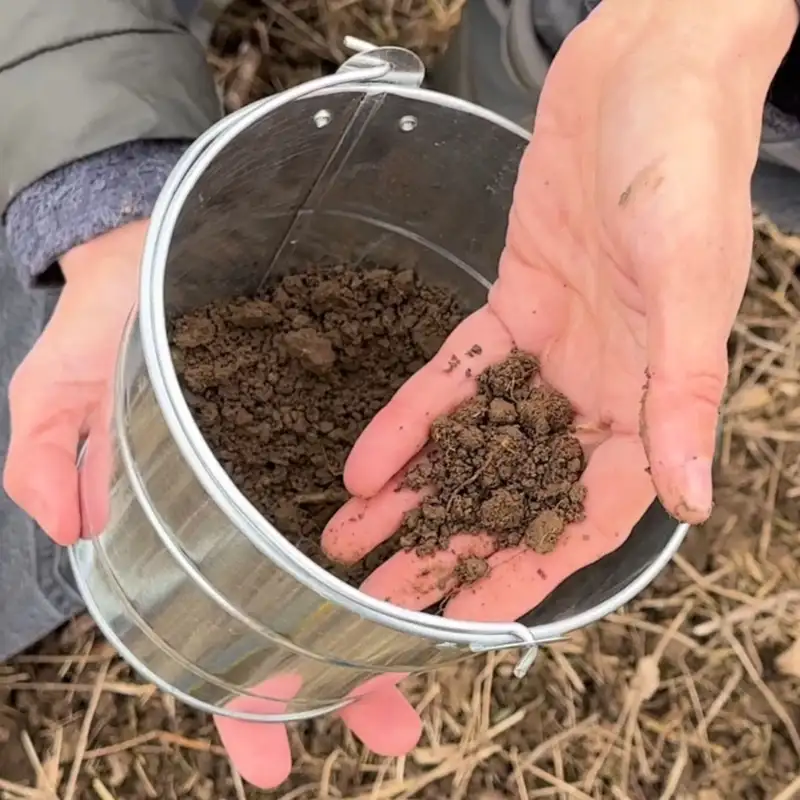
and fourth, she had a little metal bucket for collecting the soil.
Okay, what are we gonna do now?
Ariel: Alright, we have three different tools that we can use as we are either sampling the soil or we are just taking a deeper look at it. Probably the simplest tool is this little landscape flag. what this can help us with is if you just wanted to assess the compaction of an area of soil, how easily or difficult is it to move that flag into the soil?
Into what depth? So you can see, even though it's frozen here today and cold, that flag had no problem going all the way down in. So that tells me that this area, even though it's been walked on and it's been out here, it's not as compacted as some of the other areas.
And that's just a wire flag. That's just a piece of wire. Yeah. And I didn't bend it. I was not pressing hard, and it just went all the way through. So that's a really good indicator that we don't have a lot of compaction in this area of the orchard.
[00:12:11] Testing the soil with a soil probe
Ariel: The second piece, this is the soil probe. The handheld ones are a little bit more difficult to use.
I have a one that you can stand on, which is really nice if you're doing multiple soil tests. But this is great. We use a lot of these when we're doing hands-on soils classes and we want people to really get into the soil and just to have a quick way to look at that profile that we were talking about before.
So we'll see how well this goes in, if it goes in as easily as the flag did.
So we're just working it. I'm doing quite a bit of pressure here, but it's going down pretty easily, which is really nice. And that tells me, again, that we don't have a lot of compaction. The soil's fairly workable here. So now I wanna try to pull it out. Oh, look at that core.
That's awesome.
Susan: Oh, wow. Let's have a look at the color.
Okay. Yeah. So I'm looking at the color and I see, like you say, about 10 inches. It's relatively consistent. It looks muddy and a little sticky. How would you describe that core sample?
Ariel: I would say that is extremely consistent, that means that we've got really consistent soil in the top, 10 to 12 inches of the soil here in this area.
You can see there's a little bit of debris, but that's just what's on top here. that silt, it's sticky, it sticks together. There's quite a bit of and a little bit of clay in this sample. But yeah, it looks, the color is good. The fact that I was able to put that core down there with very little effort, that's why this section of the soil in this park is actually some of the best.
[00:13:55] Using the shovel to test the soil
Ariel: What's the last piece of equipment you've got there?
So the probe is great if you have one, but it's absolutely not necessary for taking a soil sample. Just a shovel is another great one, and especially if you've got arthritis or if it's just hard to navigate that probe.
If your soil is really hard, it can be easier to get that shovel into the soil and to take your samples that way. As long as you can get down far enough. see, we can still see that profile even in a shovel, full of soil. actually even see more because you see more of that organic debris at the top.
If I stood up, I could probably get a little bit deeper,
Susan: I'm noticing a lot of clumping in the soil. So you like that, right? Clumping is a good thing.
Ariel: I do.
I don't like clods, but clumping the way that it's holding together like that. That's really a good thing.
Susan: Because?
Ariel: It shows that you've got ability for roots to get through that soil to connect, to hold onto something.
If it was too crumbly, it would be like pulverized, like growing in dust. There's nothing to grab onto. And if it was really blocky and full of clods it wouldn't have good drainage or good permeability. And so the way that crumbles, to me, that's just an ideal structure.
[00:15:12] Putting your soil sample in a bucket to mix it
Susan: Okay, so now I see you're taking the sample.
And you're putting it in your little bucket there, right? What was that all about?
Ariel: So this is a smaller bucket that I would probably use if I was going to be taking a soil sample for a test here. But I would do maybe 10 cores in this area, and I would put them into a bucket, and then I would mix them really good so that we get that homogenized mix.
And then I would take a representative sample from that. then package up and send to a lab.
Susan: And what do you learn just by touching the soil?
Ariel: I love to actually feel a soil. There's so much that we can tell by just touching it and feeling it.
So one of the things is how easily it's workable and this beautiful structure. So your texture of your soil are the fundamental combinations of sand, silt, and clay in a sample. And there's not really much you can do about that. That's the natural material of the soil. But the structure is how those particles fit together.
And this is a beautiful, crumbly, not too wet, not too dry soil. And there's a little bit of organic matter in there. There's some debris, but overall that soil just looks good, it feels good, it smells good. A couple things you can do with a soil sample like this. If we didn't know the texture already from the lab that it was a silt, we can try things like, how well does your soil stay in a ball when you pinch it?
We could try making a little ribbon of the soil and that tells that there definitely is some clay and silt in there. So see that's what you would call a ribbon, right? And that's about three quarters of an inch or so. That's really interesting. And then I can also take a little bit, if I had some more water, I can rub it in my palm and I can feel those textures that are in there.
I can feel it smooth. So there's definitely that silt and clay aspect to it. And there's a tiny bit of grit. And so that tells me that there's some sand. And so loam means that there are equal combinations of sand, silt, and clay in that soil. So we have a silt loam, meaning that there's, a little bit of everything but a little bit more silt, and that's creamy. Silt is great. It holds onto nutrients and water, but it's not as sticky and unworkable as clay. So really a, pretty nice soil type for this area.
[00:17:42] Comparing Soil Samples Across the Site
Susan: In terms of this site, you have different areas or zones.
How different will a sample be from this orchard area that you chose to plant the trees, to,
for instance, the area where you hope to be planting vegetables? You said that there is another area on the other side of the mature trees over there that the soil isn't that great.
Can you describe to me what the difference would be, both in terms of what the core sample looks like, and in terms of what the results of the test would be like?
Ariel: Yeah, that was fascinating. So we took five different samples, multiple samples of each of those five. So we designated five different areas that were either managed separately or had a different future here on this park site.
And what was really fascinating is four of them came back similar in terms, at least, of the soil texture. So the soil texture here is a silt loam in four of the five samples in the sample. That was primarily from the construction area where the parking lot had been constructed, where this pathway had been constructed, where there had been a lot of disturbance and there had been a lot of material brought in.
That soil came back as a sandy loam, which is really interesting. So the native soil here is a loam, and that came through, even though there's been different activities happening all around this site. The soil pH also fluctuated a little bit. It was higher in the areas of disturbance and where more material had been brought in.
For the most part it was similar from area to area.
Where we saw the most difference was in the nutrient content and the soil organic matter. In the areas like this pasture area and the orchard that have been not as disturbed, that have been amended over time, saw a much higher soil organic matter percentage in those samples.
The area where there's been construction, where there has not been active cropping, where it's been really mostly focused on weed management, we did see soil organic matter and much lower nutrient content across the board. So a lot of those did not surprise me at all. What surprised me was that the construction area was so disturbed that it actually was in a different textural class, which is really artificial.
[00:20:02] Challenges of Compacted Soil
Susan: Ariel and I then walked to another part of the site, and it was maybe two minutes away, but oh, the soil was so different.
This area was once a construction site and the soil was barren with nothing growing on it.
You could even see tire tracks from tractors and machinery that had been on the soil, and it was like imprinted in the soil because it was so hard.
Anyways, Ariel tried her tools. She used the landscape flag. She tried to insert it in the ground and the landscape flag had a wire that's about maybe 10 inches long. She could get it in maybe five inches deep.
Then she tried the soil probe. She could hardly get an inch down into the ground,
and she had the same problem with the trowel.
So right away, Ariel could see that this soil was rock hard.
Ariel: Some of this is the natural soil. And some of it is this construction road mix that they brought in.
It's dense.
There's none of that lovely crumbling that was happening before. It's either sand or it's chunks.
Susan: Where I live, there's a lot of people who have renovations done on their property, and so they take away the top soil before the renovation. They do a lot of work. They put a lot of equipment on the soil and garbage on the grass or whatever was left under there. And then it's almost like rock hard. And then they put out like two inches of, soil from a bag and roll out some turf grass on top. You think you've got a good garden, but if you were to use that soil probe, what would you see?
Ariel: You would see almost like a layer cake of some probably rock, some road mix, some whatever debris was left over at the construction. You might find a piece of sheet rock. Who knows what is down there. And then as you get down, then you might find a really compacted layer where the renovation of the construction happened.
And under that, then you might start to see some of the native soil. Again, it depends on to what degree it was disturbed, and then what was put back. But you are probably not gonna see a deep, rich, healthy, workable soil profile.
[00:22:16] Will a fruit tree survive in soil that has had so much construction
Susan: So if you plant a fruit tree in a yard where there's been that much construction and work, will it survive?
Will it be weak? What will happen?
Ariel: It really depends on what's going on in that site. The tree might surprise you. It may continue to thrive because you might continue to give it love. You might set it up for success. But more often than not, what happens is that those tree roots, at a certain point, they either reach a compacted layer, which then they can't break through and reach nutrients, or they reach a really nutrient poor area.
And what happens in our area, if there is that compaction layer from construction or from whatever other reason, then now you have really no drainage in that area. And we see more young fruit trees die because of flooded root zone conditions and the inability to ever dry out. That seems to be the number one killer of a young fruit tree, is people water it to death, and there's nowhere for that water to go because there's no drainage in that soil.
It really doesn't have as much to do with nutrients. Not at first. The tree is really set to grow and thrive and establish itself even in a nutrient poor soil. But it's more that the structure of that soil, if it has drainage, if it is possible for the roots to move through that soil and establish themselves.
And then you can do a lot with fertilization to keep a tree alive later on. But that structure, if it can't reach a good, healthy area for rooting, then it's not gonna survive.
[00:23:57] Outro
Susan: Even if your soil is not perfect, there's a lot you can do to prepare it for fruit trees, and that's what we're gonna talk about in the next episode. That's part two of this conversation. So do you wanna be the first to know when that episode drops? Then all you have to do is go to
orchardpeople.com/sign-up/ and sign up for my newsletter, and I will notify you as soon as a new podcast drops or a new video drops, or even a new article on my website. So please do sign up at orchard people.com/sign-up,
and if you really like this show, I would love it and so appreciate it if you could subscribe, click like, click share.
All of those things are great to help other people learn about this show, and I really appreciate you guys making the gesture.
Anyways, that's it for this episode. Thank you so much for tuning in. Bye for now and I'll see you next time.
Creators and Guests