How to Read a Soil Test for Fruit Trees (and What to Try Next) with Ariel Agenbroad
Download MP3#125 How to Read a Soil Test for Fruit Trees with Ariel
[00:00:00] Soil Test Next Steps
Susan: Hey everybody. Welcome.
In the last episode of the Orchard People Podcast, we talked about how to assess your soil before planting your fruit trees, because if your soil isn't suited for those fruit trees, those trees will struggle
and you won't get
the healthy tree and the abundant harvest that you've been hoping for.
So in the last episode, we talked about really
simple ways that you can assess the soil without any fancy equipment.
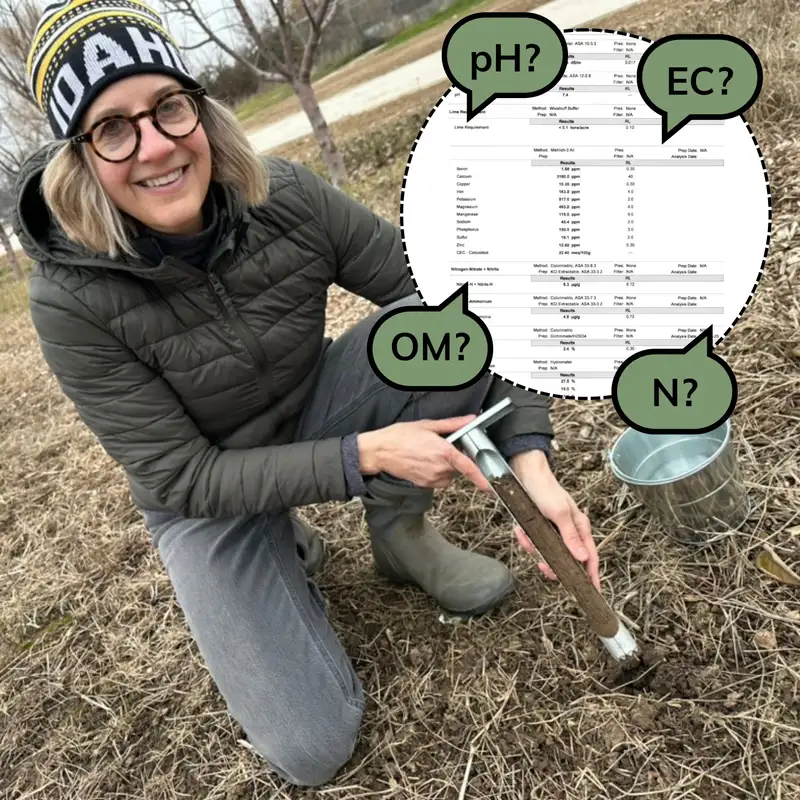
We also talked about taking a soil test so that you can see what nutrients are actually in your soil. But here's the big question. You take that soil test, you get the results. Now what do you do?
What do you do with the results of your soil test? And that is what we're going to talk about today.
So we are going to talk about how to interpret soil test results. We will talk about how to choose the right amendments to improve your soil. But the great thing is we will also talk about how to use cover crops to improve your soil so
you are not just using bottles of this and powders of that
cover crops are a natural way that you can have really healthy, rich soil that fruit trees will love.
So my guest again today is Ariel Agenbroad. She is a professor and area extension educator with the University of Idaho extension
and Ariel works with farmers and gardeners and community groups, and she's been doing this for over 18 years. We are really lucky to have her. So in the last episode, Ariel took us to see a real example,
this potential expansion of a community orchard at Spaulding Ranch.
This is a historic agricultural park owned by the city of Boise.
So today we're gonna pick up where we left off and learn so much more. Before we dig in, I'd love to hear from you. If you have questions or comments, please pop them into the comments box of the YouTube video.
If you're watching this on YouTube. Always remember to like and subscribe.
It really helps to get this podcast to go further out now.
Ariel, welcome to the show again today.
Ariel: Hello, Susan. So nice to see you again.
Susan: I'm so glad to have you back.
[00:02:16] Quick Soil Check Recap
Susan: And so let's start off with where we left off in the last episode
I was in person in Boise and you showed me a few simple tricks
as to how to evaluate your soil before you even plant a tree.
How do you know if your soil is any good? So let's do a really quick recap.
Ariel: We were using our eyes, our hands, our noses. We were really evaluating the soil based on the things that we could see, touch, smell, and feel, and what we were determining was that soil had good drainage.
We determined that by using a probe, even that little flag that we put in the ground. We were observing the color of the soil. We were looking for that darker color that might be associated with organic matter. We were looking for the way that the soil aggregates held together, that structure. And we found that it was a nice crumbly texture that held together pretty well.
And then we were also just looking at how well that soil drained, if there were pockets of water, things like that. So we were able to tell quite a bit just by looking and feeling the soil, and didn't see any major issues in the soil that was around the orchard. But to know more, I really wanted to get a soil test.
And so we also demonstrated how to take proper samples in preparation for sending them to a lab to do a full scale analysis.
Susan: Okay, so you did that and you took soil samples from various different places on the site. You sent them off to a lab. So what did the results look like and what can we learn from these results?
Like what did you learn about the Spaulding Ranch site?
[00:03:51] Spaulding Ranch Results
Ariel: Yeah, it was really fun to get the tests back. If you're a soil nerd, I guess it's really fun to get the test back. But what we got back really confirmed a lot of our observations out in the site. We tested that site that had been under a lot of construction and disturbance.
We tested that separately from the orchard, and separately, the orchard from the area that has been bean cropped. And then also we tested the area that has just been under sort of pasture cover crop for the past few years. And what we saw told a really clear story of how those different activities impact the physical and chemical properties of a soil over time. And so the area, unsurprisingly, where we had the construction and all this disturbance, that soil actually was an entirely different soil texture. It had the worst of the worst in terms of the pH, in terms of the nutrient load, et cetera.
The area that has been least disturbed, so the area that was pasture cover crop, that had the best qualities, if we wanna put a value to them. The orchard though, was right behind that, in terms of actually how good that soil is and what the test told us about that area. So it did confirm some of the things that we saw when we were there, and then it gave me more insight into what direction we need to go in terms of better supporting those trees or better preparing the ground for planting more trees.
Susan: Amazing. Okay, so we had three sites. The interesting thing is, you and I were out there without fancy tools and, what you've told us so far about texture, we figured out without even having the soil test. By feeling the soil, looking at the color of the soil, you could see that the construction site had terrible, falling apart soil, did not hold into a ball, the color was very light. So how does the soil test take us any further? Like we can do that without a chemical soil test.
[00:05:54] Why pH Matters Most
Ariel: Right. This just dials it in a little bit more specifically and gives us more information that we can use to make the best management decisions.
[00:06:01] Why pH Matters
Ariel: So a few key things. When I get the test back, I immediately look for the soil pH because the soil pH is gonna tell me the relative alkalinity or acidity of a soil, and that's gonna tell me which plant species may be more suitable for that area. If I'm going to see any problems with nutrient deficiencies, because even without knowing what nutrients are in the soil, the pH is gonna tell me often how available some of those nutrients might be in the soil.
And in particular, a lot of the micronutrients can be affected by pH. And so, if the pH is too high on the alkaline side, I know we're gonna have some plants that are gonna struggle with iron deficiency symptoms. There's gonna be other issues associated with that.
In our area, we'd never have problems with acid soils. We're too arid and soils in the west tend to be more alkaline anyway in our area. So I look for the pH, and our pH was 7.4, which might be high to people that maybe are living in coastal environments or used to like, more of an acidic soil.
But for us here in the arid west, that is an absolutely fine pH, but it does alert me that there could potentially be problems with alkalinity for certain susceptible species. So, for instance, we're not gonna grow any blueberries on that site, but our fruit trees should have no problem.
[00:07:22] Fruit Tree pH Range
Susan: Okay, so let's jump in there. So you've talked about 7.5 on the pH scale.
Fantastic.
[00:07:30] Fruit Tree pH Range
Susan: What is the range that conventional fruit trees, apples, pears, peaches, cherries, what's the range of pH that they can tolerate?
Ariel: That's a really good question. We often tell people that between 6.8, 6.9 and 7.2 or three, that's really the ideal sweet spot. The closer you can get to neutral and maybe just on the other side of acidic. And that really has to do with the most availability of nutrients in that pH range. The closer you are to neutral.
The closer you get to alkaline, there are certain nutrients that are less available to the plant. Same with the acid scale.
Susan: So alkaline is up, so you're a little bit more alkaline and acid is down.
Gotcha.
Ariel: Yeah. Or basic and acid. Alkaline, acid, right? So that 7.4, it's slightly above neutral, but it's really not a problem area. Where we would start to see possibly issues is getting up into 7.8, 7.9, even into eight. But we do have plenty of fruit growing regions in our part of Idaho that are in that range.
And the fruit trees and the grapes do okay. It's a lot of times the berries that might suffer at those higher pH levels. Fruit trees can be so forgiving, as I'm sure you know.
Susan: Wow, that's incredible. Okay. And so the other thing that I find so interesting is like, we humans, you put food on the plate, we can eat it, all the nutrients are there. We eat it.
With a fruit tree, if you put the food on the plate, the food is all in the soil. But if the alkalinity is wrong, it's like the food is there and it can't eat anything. It cannot take it in. So it just goes to show that, for that reason alone, it might be a great idea to test your soil before planting your trees if you can.
Or if you already have trees that are struggling, you might wanna test. And when you do, tell the lab you're growing, you wanna grow fruit trees, or you are growing fruit trees. Give me amendments that might help balancing balance things out if need be. So that alone, pH. Fabulous takeaway.
Okay. What else did you get out of those soil tests? And I'm really happy to hear that you have happy fruit trees already. They like it, and if you guys are able to expand, it'll be great for them with the pH. But what else did you learn from these tests?
Ariel: Great.
[00:09:55] Salt Levels Explained
Ariel: A few other measurements that I will look for on a test.
And, of course, you have to ask for some of these, depending on the lab. This may not all be part of the basic soil test. I also look for the electrical conductivity because that's going to tell me where our salt levels are in that soil, and if they're too high, then we start to see toxicities, salt burn. The salt is replacing nutrients in the solution, so when plants are uptaking nutrients in water, if there's too many salts in there, they're taking those up instead of nutrients. Our salt levels were very low, and that's good. We might see high salt levels if we have been over fertilizing or overusing manure, but we hadn't been doing either of those things, so I didn't expect that number to be high.
But that was very low. And then I also want to look at, before I get into nutrients.
Susan: Before we hop into more nutrients, I wanna talk about the salt levels.
Ariel: Yeah.
Susan: So here in Toronto, we had a lot of snow this year, a lot of ice. There is all sorts of salt on the road and you walk around in your boots, you come in the house, you put your boots on the mat.
I'm seeing crystals of salt on the mat, the salt is everywhere. Is this the kind of salt that, if it gets on your soil, let's say first you salt your driveway, then you shovel it onto your garden. Is this the kind of salt that would make it hard for fruit trees? Explain that a little bit to me.
Ariel: That's a great question, and this test is measuring the soluble salts in the soil profile. So I don't know if it would pick up on an overuse of, say, road salt, but that absolutely can have an impact on plants growing in the vicinity for the same reason. It's almost as if you're applying the salts as a fertilizer that might build up on the soil surface.
It's washed down into the root zone, and then again, those salts can cause damage.
And so you often see trees along a roadside or plants or lawn along a sidewalk in the spring showing those same symptoms of salt damage. So it's the same symptomology, but I don't know that this would be measuring the presence of road salt necessarily, partly because you are measuring further down. And so you might be looking for the long-term buildup of salts in a soil with a soil test versus the sort of seasonal overload of a salt product during the winter use.
Susan: Yeah. okay, so let's look at this. Let's think about this.
[00:12:26] Fertilizer and Manure Salts
Susan: Why would fertilizer use, put salt in your soil?
Ariel: Many conventional fertilizers are formulated with salts because they do break down in water because they're a good carrier. And so there are often salts in our fertility products, and there are definitely high salt levels in manure products as well.
People tend to think of manure as a very benign fertilizer, and while it does have a lot of benefits, it also can carry some risks in terms of the salts, the overload of certain nutrients, and then food safety questions. But that's another day.
Susan: Wow. Okay. Back to the that type of manure, which is also a fertilizer, but it's natural.
So are these horses or sheep? Are they eating salt? How's the salt getting into their manure?
Ariel: I am not an animal scientist and I honestly don't know the answer to that, why manure are so high in salt. I could look that up and they get back to you, but I don't have that answer off the top of my head. I just know that there is often a high salt content in manure and it could be with the feeding, it could just be in the makeup of their waste products, but we have nutrient management specialists at the university that would be able to answer that a lot.
Susan: That's okay.
Ariel: More knowledgeably than I can.
Susan: It's just good to know. So far we've talked about pH and we've talked about salt. And the salt test is called, what is it called?
Ariel: It's the electrical conductivity. So it's measuring, in solution, the amount of salt that registers on that test.
It's really interesting.
Susan: Gotcha. Okay. Alright. Tell me next. What else did you find?
[00:14:10] Soil Texture Analysis
Ariel: So on our particular test, we were able to ask for a particle size analysis to get that textural classification. So you and I talked a little bit about how you can use the field method to maybe get an idea of the sand, silt and clay in a soil.
You can put your soil in a jar and look at it, but we got definitively back that our soil was 27 or so percent sand, 15% clay and 57% silt. And so that makes it a silt loam and that is a very nice soil texture. It holds onto water and nutrients very well because of that high silt content and that little bit of clay.
But that 27% sand in there means that we're still getting some workability and some drainage and some of the good parts about a sandy soil. So we know that it has the potential to be sticky to be able to form clods if we work it when it's too wet. But overall, that's a lovely soil texture and one that I'm very happy with.
Susan: Sounds great. Okay. Next, I guess nutrients. This is the moment we're waiting for. What nutrition is in the soil?
[00:15:17] Organic Matter Goals
Ariel: One more, before I get to nutrients though. And that is really key. And that's our organic matter percentage. So I jumped to all these first, these sort of big picture items on a soil test.
Our soil organic matter out at the orchard was 2.4%. And that may seem low, but honestly for an arid soil in Idaho that is perfectly reasonable. I think it could be improved. So it gives us a goal to improve our soil organic matter, but certainly, we've got something to work with, at least. So that 2.4 is great.
We look for anything between one and 5% to be a target range, depending on the makeup of the soil and what's been done there. So those are the things I look at first. And then, because they all tell me, what kind of to expect with how the soil is gonna respond to water, to fertilization, to being worked.
[00:16:09] Nutrients and Nitrogen
Ariel: And then I look into where our nutrient levels are. And in our soils, here in Idaho, we typically are very high in calcium, and sometimes potassium. And that's just the native makeup of our soils. The parent material of our soils has a lot of calcium in it, and so my calcium numbers are off the charts.
That doesn't always mean that calcium is going to be immediately available to the trees in the alkaline setting, but it's just good information for me. Really, the one that I'm most concerned with, especially when we look at the growth and the productivity of our fruit trees, is our nitrogen.
And our nitrogen levels were low, and that's really to be expected because we have not been over fertilizing and we took these tests at the end of the season when the tree would've used whatever it could reach. Our numbers weren't negative, but they were low, and they do indicate that we will need the supplement with nitrogen in some form over the next growing season.
Susan: Now I'm confused here because I understood years ago that you can measure a lot of the nutrients in the soil, but nitrogen is a tough one 'cause it changes forms a lot. So do they just do the best they can with the information they have?
Ariel: What a soil test is measuring is the amount of nitrogen or ammonia in the soil that is expected to become available to the tree over the next season.
And you are absolutely correct that, depending on when you take this test, how you take this test, how long it sits in your car before you take it to the lab, nitrogen is extremely mobile and volatile. Meaning it can be released into the atmosphere via the air. It can move with water, deep into the soil.
It can be used up by the microbes that are doing our work, breaking down organic matter. So yes, it is a fleeting nutrient. And so this measure really just tells us that yes, there is a little bit of nitrogen present, but we're gonna have to add more. And so we use that number to assess how much more do we want to add, because our goal is to use nitrogen in a way that is most environmentally and economically appropriate because it can be lost so easily.
It's really a valuable resource.
Susan: Got it. Okay, so nitrogen, let's keep going. What else are we looking at here?
Ariel: Sure. I look at some of my micronutrients, and again, then I would compare them to some of my known resources on how good is that level, right? Am I gonna need to add more?
And there really weren't any red flags in here. My micronutrient levels are plentiful. So it's really about managing that pH and watching the tree and analyzing the tree to make sure that it is actually getting those nutrients.
And there's things that we could do if we were a professional orchardist.
We might be doing tissue samples of the leaves. We might be looking at that really closely to make sure that there's nothing that needs to be tweaked. But from our side, as a community or home orchardist, we're looking for really visual signs and symptoms, yellowing of the leaves, a slowness to put on fruit, et cetera.
I didn't see any major flags on my nutrient levels. My phosphorus was actually pretty good. Again, that's pretty normal in our Idaho soils, but we may wanna supplement based on what we see in the tree and we might even do tissue testing just for fun, as we're learning about this orchard.
But, the main thing that I'm concerned about, right now, is nitrogen, especially as these trees have just started to produce and now is when they're gonna need some of that nitrogen.
Susan: Amazing. Okay.
[00:19:58] Choosing Labs and Amendments
Susan: So for somebody without the knowledge that you have, I know that years ago when I started to explore soil testing, I realized that when you submit your soil test, you need to tell the lab what you wanna grow.
It's not just, here's my soil, gimme a soil test, gimme some numbers. You say, Hey. I'm growing apple trees or cherry trees or whatever, or I'm growing blueberries. You have to tell them specifically what you want and then ask them, please, when you test my soil, end it off with a recommendation of what amendments I may or may not need.
Did they give you a recommendation? Or did you not even ask for one since you knew you could figure it out yourself?
Ariel: That's a great question, and I love the labs that provide that because if they don't, then I get a call and I have to do some math for people. And I'm not the best at math. Our analytical sciences laboratory up on campus, they are primarily serving industry and serving the researchers on campus at University of Idaho.
So they just send me the list of the numbers. They do not give me recommendations. So I have to go back to reference material and work out, okay, I know that the trees on average are gonna use this much nitrogen per tree at their maturity level. What is my soil test telling me? And then I start to do a rather complicated dance of calculations and using known references to put that together.
So when you find a lab that will give you those recommendations for your area, it's golden. It's worth every penny.
Susan: And also before, this is what I discovered before you even commit to sending to that lab, you pick up the phone and you call them up and say, Hey, if I sent you my soil and I'm growing apple trees, will you send me recommendations?
And if they say, oh, I'm sorry, we don't do that, then I'm say, okay, thank you. And I call another lab. Because it's really handy to have somebody else with experience and knowledge and who knows how to do the calculations, telling me exactly in this spot, this is what you need.
[00:22:01] Amendments vs Cover Crops
Susan: Okay, so there's two ways that you can work with the issues that you have, and one of them is with amendments.
And then the other is cover crops. So in terms of pH, which is a main concern of yours and nitrogen, will you be using amendments or are you gonna go straight for the cover crop option?
Ariel: That's a great question. If our pH was higher, I might be tempted to want to use some elemental sulfur to temporarily reduce the pH around the root zone so that more nutrients could be available, but it's never a permanent fix. And folks that live on the coastal areas or that have acidic soil, they have to make the same determination with lime, adding lime to raise the pH of their soil.
So in our case, we've got the opposite problem. So we might look at using sulfur, but with a 7.4 and not seeing any signs of iron deficiency or anything like that in the trees so far, I'm not gonna worry about that. I'm just gonna be careful with the types of fertility products I use, and not make the problem worse.
Susan: So that's for the pH. And then for nitrogen, again, are you gonna opt specifically just to use cover crops or will you be going to the garden center and buying something, some interesting something to pour around the roots of your trees or spray the trees with?
Ariel: That is such a great question and because it's a community orchard, because we're looking at it with this lens of curiosity, we can experiment a little bit. Now, if I was dependent on this orchard to produce fruit that I was gonna market and sell, I would not want to have a year where I'm experimenting with cover crops, right? Because I don't know how that's gonna turn out yet.
I think this year we're gonna try some experimenting with the use of cover crops to supply some nitrogen, but we don't have any of our own data to know. Are we gonna meet all the needs of the trees just with our cover crop strategy? Normally I would say, all right, this is how much nitrogen I'm gonna need to apply per tree.
It would be easiest to go and purchase that product, whether it's an ammonium sulfate conventional product, whether it's blood meal, an organic product, how am I going to supply that needed nitrogen? But we're gonna look at using some cover crops and there's some ways that we can identify over the season.
Maybe if we are supplying enough of our nitrogen that way, but it's gonna be a fun experiment.
[00:24:26] Reading Leaf Symptoms
Susan: Sounds amazing. And what I like that you said earlier in the conversation was you are gonna be keeping a close eye on the trees. Now you said talk about iron deficiency, which can be a result that can happen when the pH is wrong.
And there's this issue of yellowing leaves. That can show you if, in the middle of the growing season, all of a sudden the leaves are looking weird. Is that what you're gonna be looking for, specifically chlorosis or yellowing leaves, or what other things are you gonna keep an eye out for?
Ariel: That's a great question.
Definitely the leaves can tell a lot of stories, right? When the bottom leaves of a plant start to show yellow pretty consistently, and the top growth is green, that can be an indication that we are lacking in nitrogen because the tree is gonna send nitrogen to the most needy points, which are gonna be the growing points, and the older leaves start to deplete.
So that can be a symptom.
[00:25:22] Reading Leaf Clues
Ariel: If we're seeing yellowing between the veins of the leaves, but the rest is remaining green. That can be a sign of iron chlorosis and that might tell us that we are over watering, or that our pH is causing the problem. There's a whole complex of issues there, but certainly the leaves can tell us a story about that.
But with a tree, it's often delayed so we're gonna be watching closely. Ideally, if we had unlimited funds, we'd be doing tissue samples right away, at different key points in the tree's growth and development to tell us that.
But this isn't purely a research orchard, it really is a community orchard, so we're gonna be looking for some of those visual signs as well.
[00:26:03] Cover Crops Explained
Susan: Great. Okay, so you know you've got two main things to work on now. Let's talk about cover crops and, before we dive in, what are they and how does this work?
Ariel: Yeah, this is so fun and I've been having a really good time diving into the use of cover crops in orchards, looking at all the available research and some of the different strategies that people are trying. But in general, a cover crop is something that you're growing, not for the harvest of that crop, for its food value to us, or that we're going to market that crop. It's something that we're growing specifically to benefit the environment.
So it's something that we're growing that we either intend to let die and remain in the area, or it's something that we're going to incorporate into the soil. Like maybe we're gonna till it back in, maybe we're going to let it die and we're gonna plant right into it. And so have a no-till system.
[00:26:58] Benefits for Orchards
Ariel: So we use cover crops for a number of different things. Number one, to conserve soil moisture. Having some kind of cover on that soil reduces the moisture loss. It can help cool and shade the soil. It can do wonders with soil erosion because if the soil has roots holding it together, it's not gonna blow away. It's not gonna run away in a rainstorm.
We can use it to suppress weeds. So a lot of our common weeds are very non-competitive with other plants. So if we get something growing in that spot, then we have fewer weeds. And then we also can use it to increase the soil organic matter by putting more debris into that soil, more root mass.
We can also use it to supply key nutrients, so any of our leguminous crops, right? Things in the pea and bean family. They're fixing nitrogen in the soil, bringing nitrogen in. Others are nitrogen scavengers, so they'll pull the nitrogen from the soil, like maybe there's too much, if we had an overuse of fertilizer, they could use that up and sequester it, and then slowly release it as it's being broken down.
And then another great option for using cover crops is sometimes you can use them to attract pollinators and other beneficial insects. So lots of potential benefits. There are a few potential downsides that are related to those benefits, but we can talk about those in a minute.
Susan: Yeah. So as you're telling me, why doesn't everybody do cover crops, including commercial orchards?
[00:28:32] Choosing the Right Mix
Susan: It just sounds like a win-win situation. I guess that the issue is not randomly choosing some seeds and throwing it in the ground, but carefully choosing the seeds for the purpose that you're looking for.
I have an article on my website about cover crops, and there's a link to a Midwest Cover Crops Council cover crop tool where you put in what part of the continent you live in and what do you want. Do you want nitrogen or do you want weed suppression, or do you want more organic matter?
Because the seeds that might be perfect here, might be terrible for you where you live. They may not grow or they may be invasive. So the trick, I think, is choosing the right seeds for cover crops.
Ariel: Absolutely. And I often tell people it's like the most complex kind of matchmaking. I've got some great resources, like this book from the USDA: Managing Cover Crops Profitably. It's my little bible of cover crop.
And then what you were talking about, those cover crop calculators, we have one from Oregon State University that we use here in our part of the country.
Exactly that same thing.
[00:29:55] Risks and Tradeoffs
Ariel: Some of the issues with cover crops is, sometimes they can actually steal the nutrients that you're trying to apply to your plants so they can actually compete with the plants that you're trying to grow.
Sometimes they can be wonderful repositories for pests. There could be diseases that they are an alternate host for. They could provide a great deal of shelter for other pests that you don't want. Insects. Notoriously, cover crops can be a great protection for gophers and voles. So if you have those problems in an area, they can contribute to that.
They can also sometimes provide too much nitrogen to a plant.
And then the other hardest part is that sometimes they don't die depending on what you choose, and then they can become weeds themselves. Either they're flowering and setting seed, or they become a perennial and you can't get rid of them.
So yes, choosing what you want to provide, what benefit, when you time it for the planting if you have water available to it, it's very complex. And for some growers it's a gamble and it's an expensive way to approach it.
I do know a lot of certified organic growers that is one of their key tools, and so they have become very good at using cover crops. But often in a conventional system, it may not immediately pencil out, or we don't have enough guidance for how to use it in a really efficient and economically effective way because there's so many factors. You can't just prescribe a cover crop for a given situation.
[00:31:33] Experts, Research Gaps, and Finding Local Expertise
Susan: Are there experts? You would think that, with the growing interest in growing organically and naturally, that there might be some people who are just digging deep and developing a real expertise so you can invite them to your site and say, listen.
These are our issues. Here's our soil test results. You see our location, we are in Boise, Idaho. Help us choose the cover crop seeds that won't be invasive, that hopefully will die over the winter, because if it doesn't die, that might mean you need to till. And a lot of people don't wanna till because it could kill the beautiful microorganisms in the soil that are doing us such a good service of breaking down organic matter. Are you aware that there's an increasing number of experts in this topic?
Ariel: There are a number of really good experts in larger agricultural settings, so in larger row crop settings or in large scale crop rotations. That's where a lot of the research has been done in cover cropping, and so it's not always applicable to our little one third of an acre orchard.
It's how to use cover crops in giant rotations with wheat and barley and sugar beets, and even crops, like onions. So we do have a lot of experts out there. We've also got folks that are working on cover crops for grazing livestock and integrating livestock into a cropping system.
So there is a lot of research, but when I'm looking at our small scale, or like a garden scale, we've gotta take what we know from the larger applications and downsize it ,and that can be a little bit tricky. It's still an emerging field on the smaller scale. There is a lot of really good information too out there about the use of cover crops in diversified organic vegetable systems.
But it's still a new area in orchard management. Washington State has been leading the way in a lot of that research, and that's where I've gotten some of the ideas for what we wanna try. But there has not been a lot of real conclusive this is "cover cropping 101 for orchards."
[00:33:48] Spaulding Ranch Plan
Susan: Okay, so let's go to Spaulding Ranch to this community orchard. And you're gonna be going shopping for seeds for these cover crop seeds. What is top on your list of considerations for Spaulding Ranch?
Ariel: It's so fun to talk about this. So I sat down with the farm manager out at the property and we had all of our books and we were looking at the map and we were talking about what we wanted to do.
And so what we determined is, we have alleys right now between the rows. We have four alleys between the rows of trees, and then we have alleys on the outside of the orchard. And right now that's all grass because that's easy to mow and just take care of.
And then the area right under the trees is kept clean for a number of different reasons so that we don't get weed competition, so that we don't have rodent hiding in there. So we're looking at those alleyways between the trees, and what we decided we would do is that we would try a soil building and nitrogen fixing mix in the alleys between the trees.
And that we would focus on a beneficial pollinator and predator mix, so a flowering mix on the two outside edges. And these are about 100 feet by 12 feet (roughly 30.5 meters by 4.7 meters) each of these alleys. So that's what we'll focus on first.
So then we started to think about what will we actually put in that mix, and we looked at a combination of what she still had supply of from her other cover cropping adventures on the property with what we might wanna purchase to specifically put in place. And I did get a little mini grant from the university to try some of these things out.
[00:35:31] Mow and Blow Method
Ariel: So what we're looking at right now is we're gonna try something called a mow and blow.
Susan: I've heard of chop and drop. Okay. Mow and blow. Okay. There's chop and drop and mow and blow. Okay.
Ariel: So very similar to chop and drop, only we are gonna move the drop. We're gonna move it to a blow. Because like I said, we're gonna keep the area underneath the trees clean. So how do we get the benefits of the cover crop into the root zone of the trees? 'cause they're still young, right? So we're gonna grow a mix of kind of a taller annual clover, some triticale, potentially some vetch, and then maybe some oats or another grassy species, just so there's some more bulk.
At key points in that cover crop's lifecycle, when the nitrogen fixation is at its highest, you mow the cover crop and then you blow the debris onto the tree line. And then, as that is broken down, those nutrients are made available to the tree. That's the theory, anyway. And so we're gonna give it a try.
We're gonna see how this works.
Susan: Could you rake it? If you don't like blowers, could you rake it instead?
Ariel: You could absolutely mow and rake. Yes. You could wack and rake if you had a really small area. You could just use a weed trimmer or a weed whacker and then just rake the debris over onto the base of the trees.
We're not gonna try to smother it. We're not looking at two feet of debris. Just mowing and then moving that to the, drip line of the trees. We're hoping that'll break down. It'll create a little bit of those great effects of a mulch, so cooling, moisture retention, and then also increasing biological activity and hopefully returning some of those nutrients to the tree.
We don't know yet. Will we meet all of our nitrogen needs that way? I don't know yet. So that's gonna be the experiment.
[00:37:31] Flower Strips for Insects
Susan: So that's the cover crop mix where the trees are. But you have your cover crops for flowering insects on the outside. Those, I guess, you don't want to mow because you want them to blossom and attract beneficial insects.
Am I correct?
So you'll basically two rows of beautiful flowers, wild flowers.
Ariel: We're very excited about that mix too. And so what we're looking for there, is a mixture of plants that will attract pollinators and then also will attract some predators. So we're looking at bringing in things like, they're pretty common, cosmos, maybe sunflowers, those tall, big attractors, plants in the mustard family.
Phacelia, which is a purple flowered plant that's highly attractive to native bees as well as honeybees. And then we're also gonna put some crimson clover, some buckwheat, and some alyssum in there. These are a little bit lower growers, very attractive to pollinators. And the alyssum, in particular, seems to be a favorite host of the syrphid flies, which are pollinators in their adult life stage and predators in their in their larval stage. So we're gonna see what kind of impact we have there. And how we would measure that is, we would go out and we would do some sweeping. We might use some different techniques to capture, count and release the kinds of insects that we find there.
And I think it'll just be gorgeous too.
[00:38:59] Broadcasting and Weed ID
Susan: It's gonna be gorgeous.
Now here's my question. So in our park and I always write in my books, if you're planting fruit trees, make sure you are planting nearby some beautiful pollinator garden with flowers that blossom throughout the growing season.
So if you're trying to entice the beneficial insects to come and stay on your site throughout the season, giving them everything they need, the habitat, the food, whatever. But we think about where we put the flowers, we weed around them. We make it all look pretty. Is this planting going to be, whoops, A bunch of wild flowers and a long strip?
And you're not gonna think about, let's put the cosmos here and the sunflowers there and make it a really pretty arrangement. Are you not concerned with that?
Ariel: Probably not so much because we've got a hundred foot by 12 foot rows. So there's gonna be some broadcasting, there's gonna be, what comes up?
But we are going to put the alyssum, in particular, at the ends of those rows, like four feet of just alyssum because it is so small and potentially less competitive with some of those bigger flowers. But the other is going to be a mix. And we might move in some of our other additional cover crop seed that we have just to bulk it up and to have enough, because that would be very expensive, an all flower mix.
So we'll look at what else we need to do to have that quantity of seed to cover that much ground. But no, this'll be more like a, what comes up? And that'll be good information for us too, to know what we could continue to plant there that is successful, that establishes well and that blooms and flowers all season.
Susan: I like what you're saying because
you and I together, we went to a beautiful garden store.
We were browsing through the seeds,
but a small package of flowering seeds is quite expensive. And so if you've identified what seeds, what flowers your site likes, then you're not gonna waste your money on ones that just aren't gonna come true, they will not blossom. They will not grow. Another mystery for me is if you do plant in that manner where you're just broadcasting the seeds and seeing what comes up. If you don't have any expertise, how do you know what's a weed? So you can weed it out.
Ariel: That's a great question.
And even if you have the expertise, you don't always know right away because seedlings often look the same. And so many of our weeds are related to the plants that we cultivate. Just a totally offside shoot. We once wanted to grow quinoa in a community garden. We also had a real problem with common lambs quarters in this community garden.
And the two are sisters, like they are in the same family. They look identical for most of their life. And so we even sent photographs to one of our researchers that grows quinoa on a research plot. And she was like, I don't know, we're gonna have to wait until it flowers. And it turns out we did have a lot of quinoa, which was great.
You don't always know right away. We will plant densely enough with the things like that buckwheat and some of those other plants that hopefully we won't get a big upswing in weeds, but we'll be watching and maybe hand weeding a little bit if we see things that are obviously not what we planted, like thistle or some other things like that.
It's a little bit of a leap of faith for a while until you, until they get bigger.
Susan: I like how, over the years, you'll see what are the flowers that work best? And also on a big site like that, it's not like a smaller garden where you want your perfect little perennial garden.
It's a farm. It's a beautiful farm and it's natural. So that is such an exciting plan.
[00:42:49] Planting Timeline and Reseeding
Susan: How will this unfold from here? When would you be doing your planting and what's the timing?
Ariel: Yeah, we're watching the weather. You were here on the coldest part that we've had all winter.
It has been extremely mild right now. We've got bulbs starting to bloom. The buds are swelling. It's a little bit worrisome because we could still have a lot of cold weather before May, so we're gonna be watching the weather.
Some of these cover crop seeds, especially the ones that are gonna be in our nitrogen strips, they can be planted before last frost, so we're gonna be ordering those seeds in the next couple weeks and getting ready. My friend at the park was talking about wanting to plant those in April.
And then for a lot of the flowering plants in the flower borders, we might need to wait until just after last frost to get those in the ground. So we'll be timing it that way.
And we may have to plant again, like a late summer, early fall crop in the nutrient rows because some of those, once we mow them, that can actually lead to the plants just die off after that. Again, there's gonna be a lot of learning that has to happen of, do we need two cover crops per season in those fertility strips?
And then what in the flowering strip, if anything, will over winter or reseed? So a lot of trying, data collecting. Not exactly sure what to predict in all situations yet, but this is gonna be happening immediately. I gotta get busy.
Susan: That is so fun.
And when I first started learning about cover crops, and for those listeners who are interested in learning more,
I have at least one other episode where we dig really deep into all the different options of which seeds do what. Commercial growers can sometimes do three cover crops a year, different ones at each stage,
especially if they're preparing to plant a big orchard in, let's say two, three years. They can do two years of different layers of cover crops. They have developed this into such a science, but for those of us who are home growers, community growers, and for everybody, it sounds like it is an experiment, right?
Ariel: Yeah.
Susan: Isn't that the beauty of nature? Because every site is different. Every soil is different. The way the community raised the trees is gonna be different. My feeling is, it's about showing up and being attentive. That's almost more important than perfection.
And doing the research and seeing the joy in getting to know your soil and your trees. I've always seen trees as these wonderful beings that I'm getting to know, and now I'm seeing soil as something that's got so much going on and it's so unique with its own character.
How do I match make the perfect seeds to go with it.
Ariel: Yeah.
[00:46:03] Measuring Results with Soil Tests
Ariel: And it's just fun too, because I think a lot of gardeners and farmers have this insatiable curiosity. If I do this, what will happen? And so we'll go back through this coming fall, and we'll take those soil samples again and we'll see what impact, if any, these activities had? We'll be looking at the population of the pollinators and beneficial insects, but we'll also again test the soil and see if we impacted the organic matter, if we significantly changed the nitrogen levels in that soil. It'll be really neat to see what impact, and we'll just watch the trees and how they're yielding and how they're performing and the quality of the fruit.
Susan: But that's interesting because you just brought it full circle. We started off with testing the soil, and this is what you discovered. You tested the soil and you said November. So will you, for sure, in the exact same time of this coming year, are you gonna do another November soil test and take that test and send it to the exact same lab?
Because if you send it to a different lab, it might do things differently and look side by side to see what difference is made. Is that the whole part of the experiment is, test again?
Ariel: Yes. Yeah, because otherwise we wouldn't have the conclusive data for if we're making progress. And this is gonna be especially key in some of those other poorer areas of that farm.
We're gonna be doing some different cover crop applications over there to try to break up the soil, to increase or put back all the good things that were taken out of it. So yes, that testing, again, is how we track our progress and know if we're on the right path.
[00:47:55] Advice and Resources
Susan: Are there any suggestions or thoughts that we haven't talked about or anything you wanna share with the listeners that will help them on this journey to prepare their soil for fruit trees?
Ariel: Yeah, I would say knowledge is power, right? The more you can determine about your current site based on your observations, if you have the budget to have a laboratory test done, absolutely that can really clarify some things and give you those concrete pieces of information.
But yeah, really data and observation and then trying and doing as much research as you can prior to trying so that you're not necessarily gonna be wasting your money or your time. Like we said, these seeds are expensive. Find out if commercial growers in your area are using any of these things or your farmer's market vendors. Are they trying these techniques?
What's worked for them? They'd be happy to share with you. As a home gardener, you're not competition. And I think a lot of our growers that are using these really sound practices would like more people to adopt them. And then don't be afraid to experiment on a small plot and see what your results are.
Just try it.
Susan: Go for it guys.
Ariel: Yeah, that's what we're gonna do. We don't know for sure. We have no guarantee that this is gonna work, but we're gonna have fun trying.
Susan: I think that's great.
[00:49:12] Where to Learn More About Ariel and Spaulding Ranch
Susan: So Ariel, how can people find out more about you and about Spaulding Ranch? Tell us a little bit more if people wanna learn more about the project.
Ariel: Yeah. So this is a historic park site in Boise, Idaho. It's currently being developed into an agricultural park for the community. It's been slow going. It's pretty rustic right now. But you can go online and look for Spaulding Ranch, Boise. The park's department does have a website.
I'm currently putting together a little sister site that highlights the work that we're doing through University of Idaho Extension on the site where I might be posting some of our practices and tracking our progress. That one's not live yet. I need to get okay from the city that we're gonna be doing this and how it's all gonna fit together in the terms of our agreement and our partnership. But there is gonna be a lot more coming.
And then if folks are in our area, we're gonna be doing a number of in-person workshops, hands-on, implementing and learning about all these things. That's gonna be exciting. But if they're just curious and they're from afar, they can reach out to me, they can go to the main Spaulding website from the park, and then watch for my site that hopefully will be launching this spring.
[00:50:26] Final Wrap Up
Susan: Thank you so much for coming on the show today and for the listeners, if you wanna learn more about today's topic, we will be putting together an article and that will link you to more information from this interview about cover crops. We'll also bring in some information from the previous interview so you'll get lots of good content there.
And if you guys want tips about fruit tree care, podcast updates, and articles sent to your inbox, you can sign up at orchardpeople.com/sign-up. There's a sign up for our newsletter so you know when new things are coming along. And that's all for the show today. I hope you're going to join me again next time, but in the meantime, enjoy your fruit trees, everyone, and thank you so much for joining us.
Take care, and bye for now.
Creators and Guests